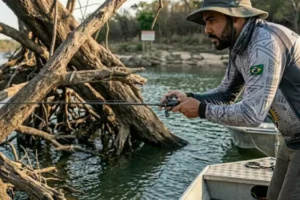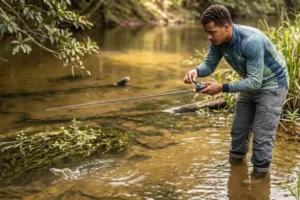
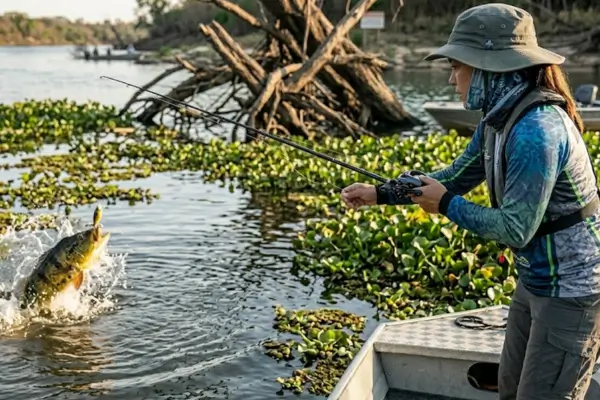
Using topwater lures in areas with floating vegetation is one of the most effective strategies for boat fishing in rivers, lagoons, and reservoir backwaters. Environments with surface cover often concentrate active fish near the top layer of the water, creating excellent opportunities for precise presentations and controlled lure movement.
Under these conditions, lure action must be adjusted to move through narrow corridors, vegetation edges, and small openings without losing natural movement. In addition, retrieval rhythm directly influences how fish respond to the presentation.
The combination of proper boat positioning, trajectory control, and interpretation of surface reactions allows anglers to explore covered areas more efficiently and improve overall fishing performance.
How Floating Vegetation Influences Topwater Action
Floating vegetation completely changes how topwater lures behave.
Leaves, grass, aquatic plants, and floating vegetation mats create natural lanes through which the lure must travel.
These obstacles reduce available working space and require greater control over every movement during retrieval.
In addition, vegetation influences fish positioning, as fish often remain near edges or within small openings between plants.
Understanding how vegetation changes water movement and fish behavior greatly improves presentation strategy.
Boat Positioning for Better Lure Movement Lines
Boat positioning is one of the most important factors when working topwater lures in covered areas.
Small angle adjustments can open cleaner lanes and improve lure access through vegetation structures.
When the boat is positioned correctly, anglers can maintain a more stable and controlled presentation line.
Good positioning also reduces the need for exaggerated movements during retrieval.
Maintaining proper distance from vegetation further helps preserve casting accuracy and presentation subtlety.
Choosing the Best Entry Point Over Vegetation Cover
Correctly defining the lure entry point makes a major difference in presentation efficiency.
In areas with floating vegetation, small openings often function as natural travel lanes for fish.
Positioning the lure close to these spaces greatly increases the chances of keeping the presentation inside the active zone.
Smooth and controlled lure entry also reduces excessive surface disturbance and creates a more natural presentation.
Casting accuracy is essential in this type of environment.
Retrieval Rhythms to Create Natural Movement
The rhythm applied through rod action directly influences lure behavior.
Soft and steady movements create more natural displacement, while faster sequences produce more aggressive surface action.
In areas with floating vegetation, rhythm control helps avoid unnecessary contact with plants and keeps the lure inside open lanes.
Different retrieval rhythms also allow anglers to explore varying fish responses throughout the fishing session.
The ability to alternate movements is fundamental for maintaining efficient presentations.
Using Pauses to Stimulate Surface Activity
Pauses are extremely important when working topwater lures.
Temporarily interrupting lure movement creates behavioral changes in the presentation and may increase fish interest.
In many situations, short pauses near vegetation edges produce excellent results.
Pauses also help keep the lure longer in productive surface areas.
The combination of movement and interruption creates a more dynamic and less predictable presentation.
Controlling the Lure to Avoid Vegetation Contact
Maintaining precise trajectory control is essential in environments with vegetation cover.
Exaggerated movements or abrupt direction changes greatly increase the likelihood of contact with leaves, branches, and shallow roots.
For this reason, lure action should prioritize short, controlled, and well-directed movements.
Visually monitoring lure position during retrieval also allows quick corrections whenever necessary.
This control significantly improves presentation fluidity.
Alternating Movement to Maintain Fish Interest
Changing movement patterns throughout the retrieve is a highly effective technique in areas with active fish.
Continuous sequences can be combined with quick accelerations, short pauses, and subtle rod twitches.
This alternation creates less predictable presentations and increases lure visibility on the surface.
In many situations, subtle rhythm changes make a major difference in fish response.
The ability to continuously adapt greatly improves consistency.
Reading Surface Reactions for Quick Adjustments
Carefully observing water behavior helps identify presentation efficiency.
Movements near the lure, surface disturbances, and shifts in vegetation indicate how fish are responding to the lure action.
These reactions allow anglers to quickly adjust retrieval speed, rod movement intensity, and pause duration.
The faster these signals are interpreted, the greater the overall efficiency tends to become.
Continuous environmental reading is essential for maintaining productive presentations.
Maintaining the Presentation After Missed Strikes
Not every fish interaction results in an immediate hookup.
In many situations, fish simply follow or touch the lure before temporarily moving away.
For this reason, completely stopping the presentation after a missed strike often reduces efficiency.
The ideal approach is maintaining controlled lure movement while adjusting rhythm and direction according to observed reactions.
This continuity frequently increases the chances of additional interactions in the same area.
Influence of Water Conditions on Lure Action
Water color, surface movement, and current intensity greatly influence topwater lure behavior.
In calmer water, smoother movements usually produce better presentations.
In areas with more surface disturbance, stronger rod movements help maintain lure visibility.
Adjusting retrieval rhythm according to environmental conditions significantly improves lure performance.
Equipment Adjustments for Better Control
The equipment used directly affects lure control.
Light and sensitive rods facilitate fast and precise movements.
Proper line selection helps maintain continuous contact with the lure during retrieval.
Balanced reels also allow smoother speed adjustments throughout the presentation.
A well-balanced setup greatly improves efficiency in vegetation-covered areas.
Importance of Casting Accuracy
In environments with floating vegetation, casting precision is just as important as lure action.
Placing the lure exactly into small openings between plants greatly increases fishing efficiency.
Accurate casts also reduce excessive corrections during retrieval and preserve presentation naturalness.
Practicing controlled casting significantly improves access to productive areas.
Common Mistakes When Working Topwater Lures
Some mistakes greatly reduce presentation efficiency:
- Working the lure at the same rhythm continuously
- Using excessively aggressive movements
- Ignoring vegetation positioning
- Failing to use pauses during retrieval
- Retrieving too quickly in tight areas
- Making unnecessary abrupt direction changes
Avoiding these mistakes greatly improves presentation control and natural movement.
Techniques for working topwater lures in areas with floating vegetation require precision, control, and continuous adaptation.
The combination of proper boat positioning, accurate lure placement, and rhythm control allows anglers to create more efficient and natural presentations.
In addition, continuous observation of surface reactions helps quickly adjust lure behavior according to environmental conditions.
With practice and constant refinement, anglers develop greater mastery over lure presentation and improve fishing efficiency in vegetation-covered environments.