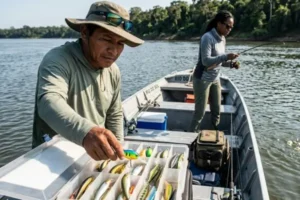
Choosing artificial lures for river fishing in environments with submerged structures and predatory fish is one of the most important factors affecting angling performance. These environments present complex conditions, including logs, rocks, aquatic vegetation, and depth variations that directly influence how lures behave in the water.
In such conditions, it is not enough to simply select a popular or visually attractive lure. It is necessary to understand how each model performs underwater, how it reacts when contacting structures, and how it adapts to different layers of the environment. The correct combination of these factors increases fishing efficiency and improves lure presentation in areas where predatory fish are more active.
How Submerged Structures Influence Lure Selection
Submerged structures act as reference points within the river ecosystem. They provide shelter, resting zones, and movement corridors for predatory fish. At the same time, they create flow variations and transition areas that influence fish behavior.
These structures also concentrate small aquatic organisms, increasing feeding activity around them. For this reason, lure selection must consider not only the target species but also the type of structure present in the area.
In areas with logs and branches, more compact lures with lower snagging tendency tend to perform better. In rocky or irregular bottom areas, lures with better depth control are often more effective.
Most Effective Lure Types in Obstacle-Rich Environments
In rivers with submerged structures, some lure types stand out for their versatility and efficiency:
- Surface lures for areas near floating vegetation
- Mid-water lures for intermediate depth zones
- Deep-diving lures for bottom-oriented environments
Each type serves a specific purpose within the fishing system. Surface lures are more effective when fish are active near the top layer, while mid-water lures work well in transition zones.
Deep-diving lures are ideal when fish are concentrated near bottom structures. The correct choice depends on environmental reading and fish behavior observation.
Shapes and Profiles That Improve Navigation Through Structures
Lure shape directly affects its ability to move through submerged obstacles. More compact models tend to pass through tight areas more easily, reducing interference during retrieval.
Hydrodynamic body designs are more efficient in confined environments because they reduce water resistance. This allows smoother movement through logs and vegetation.
On the other hand, larger-profile lures can be used in more open sections of the same river system where structural interference is lower.
The shape selection should always match environmental complexity and available movement space.
Working Depth and Lure Position in the Water Column
Working depth is one of the most important factors in structured river fishing. Predatory fish can occupy different water layers depending on temperature, light conditions, and food availability.
Surface lures are effective during periods of higher activity near the top layer. Mid-water lures are useful in intermediate zones where fish move between layers.
Deep lures are ideal for areas closer to the bottom, where submerged structures provide shelter and concentration points.
Controlling working depth allows anglers to target specific zones with higher fish activity.
Colors and Finishes in Water with Different Visibility Levels
Water visibility plays a major role in lure color selection. In clear water, natural colors tend to perform better because they closely resemble local aquatic organisms.
In murky water, high-contrast colors help increase lure visibility. This makes it easier for fish to detect the lure even under reduced visibility conditions.
Lure finishes also affect performance. Glossy surfaces reflect more light, while matte finishes provide a more natural appearance in certain environments.
Color and finish selection should always be based on specific river conditions.
Vibration and Signal Emission to Attract Predatory Fish
Lure vibration is one of the main factors influencing predator response. This movement creates underwater signals that can be detected from a distance.
High-vibration lures are useful in open areas where signal dispersion is greater. Subtle vibration lures are often more effective in structured environments with limited space.
In addition to vibration, water displacement and movement patterns also influence lure effectiveness.
Adjusting Lure Size According to Fish Size
Lure size should match the average size of fish in the area. In rivers with larger predatory fish, bigger lures may be more effective.
Smaller lures are useful in situations where fish are more selective or less active.
Size also affects lure behavior, including sink rate and movement during retrieval.
This adjustment provides flexibility in fishing strategy.
Choosing Hooks and Trebles to Reduce Snagging
Hooks and treble hooks play an important role in lure performance in structured environments. Compact and well-positioned hooks help reduce contact with obstacles.
In areas with logs and branches, this detail improves lure movement efficiency.
Hook configuration also influences landing success, especially when fish move quickly during the fight.
Adapting Lures to Different Types of Submerged Structures
Each type of submerged structure requires a different approach. In log-heavy areas, more durable lures with lower snagging tendency are preferred.
In rocky areas, lures with better depth control perform more effectively. In vegetation-rich zones, lighter and smoother-action lures are usually preferred.
This adaptation improves efficiency and reduces lure loss during fishing.
Common Mistakes in Lure Selection for Structured Environments
Some mistakes can reduce fishing performance:
- Using lures not suited for the structure type
- Ignoring lure working depth
- Choosing colors without considering water visibility
- Not adjusting lure size to the environment
- Using lures with high snagging tendency in tight areas
- Not observing fish behavior before selection
Avoiding these mistakes improves consistency and overall efficiency.
Choosing artificial lures for river fishing in environments with submerged structures and predatory fish requires careful analysis of multiple technical factors. Shape, depth, color, vibration, size, and durability all work together to determine lure performance.
When properly adjusted, these elements allow better lure presentation and improved efficiency in complex environments. Understanding these variables enables anglers to adapt more precisely to river conditions, resulting in more consistent and effective fishing performance.