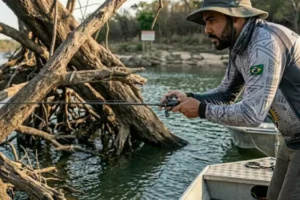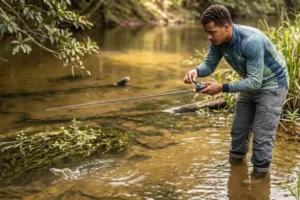
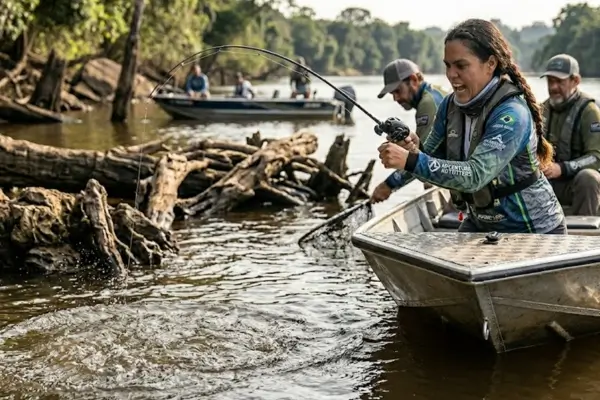
The hookset is one of the most important stages of boat fishing, especially in environments with submerged structures and hard-mouthed fish. In these situations, it is not enough to simply notice contact with the lure. The angler must execute the movement at the correct moment, with proper intensity, while maintaining full control of the setup.
Logs, submerged branches, rocks, roots, and natural underwater structures create scenarios that demand quick reactions and precise movements. Many species use these locations as holding and movement areas, taking advantage of nearby cover to quickly change direction after contacting the lure.
For this reason, developing an efficient hookset technique becomes essential for improving fishing consistency. Line control, rod position, reaction timing, and lure type all directly influence the outcome.
In addition, continuous practice helps anglers adapt their response according to depth, fish behavior, and surrounding conditions.
How Hard-Mouthed Fish React to the Lure
Hard-mouthed fish usually respond quickly and firmly when moving toward a lure. In many cases, contact occurs close to submerged structures, where fish take advantage of the environment to reposition themselves immediately after the initial strike.
Depending on the situation, the fish may only hold the lure briefly before changing direction.
This behavior requires constant attention and the ability to interpret what is happening below the surface.
Not every strike feels the same. Some responses are subtle, while others generate stronger vibrations transmitted through the line and rod.
Learning to distinguish these situations greatly improves hookset accuracy.
Ideal Timing for an Efficient Hookset
Proper timing is one of the most important factors for achieving effective force transfer between rod, line, and hook.
Setting the hook too early may pull the lure away before proper hook positioning occurs.
On the other hand, waiting too long allows the fish to use nearby structures to quickly reposition itself.
For this reason, developing awareness of the ideal moment between the strike and rod movement makes a major difference.
With experience, anglers begin recognizing response patterns according to fish type, depth, and lure model.
Adjusting Timing Between the Strike and Rod Action
Not every situation requires an immediate reaction. Depending on fish behavior and lure presentation, small adjustments in response timing can significantly improve efficiency.
In some cases, an instant response works best. In others, waiting a fraction of a second helps improve hook positioning.
This adjustment depends on factors such as:
- Retrieval speed
- Presentation depth
- Type of submerged structure
- Lure size
- Fish behavior during the session
Practical experience is essential for developing this awareness.
Rod Position for Better Force Transfer
Rod position directly influences hookset efficiency.
Keeping the rod at a balanced angle improves force transmission through the line and into the hook.
In areas with submerged structures, very low rod positions may limit movement range, while excessively high positions reduce control after the hookset.
The ideal approach is maintaining a comfortable and ready posture.
Proper alignment between the rod and line direction also improves overall setup stability during critical moments.
Short Hookset Versus Wide Hookset Around Structures
Choosing between a short or wide hookset depends on the available space and presentation conditions.
Short hooksets usually provide faster responses and greater control in tight environments.
This movement works especially well near submerged branches and logs.
Wide hooksets tend to create stronger force transfer in more open areas.
Adjusting hookset range according to the environment significantly improves efficiency.
Knowing when to use each movement is a skill developed through practice and observation.
Line Control to Avoid Losing Contact During Critical Moments
Line control is one of the most important aspects during the hookset.
Excess slack reduces force transfer and decreases strike sensitivity.
On the other hand, excessive tension may negatively affect the lure’s natural presentation.
The ideal balance is maintaining continuous contact with the lure while still allowing natural underwater movement.
This balance greatly improves response capability during critical moments.
Good line control also helps identify subtle changes during retrieval.
Directing the Hookset to Pull Fish Away from Structures
In structured environments, hookset direction makes a major difference.
After contacting the lure, many fish immediately attempt to return to nearby logs, rocks, or submerged branches.
For this reason, directing the rod toward open water helps maintain better control during the first few seconds.
This movement reduces fish proximity to natural obstacles and improves handling stability.
Proper rod positioning also makes later adjustments easier during the fight.
Quick Reaction After the Hookset to Maintain Control
The hookset does not end with the initial movement. The reaction immediately afterward is equally important.
Maintaining constant pressure on the line helps preserve contact and improves fish control.
Very abrupt movements may reduce setup stability.
The ideal approach combines firmness with smooth control throughout the sequence.
This continuity greatly increases efficiency in structured environments.
Adapting Technique According to the Type of Lure Used
Each lure type requires specific adjustments in hookset technique.
Topwater lures usually create faster and more visual reactions, while mid-depth and bottom lures often transmit different signals through the line.
In addition, single hooks and treble hooks change how force is transferred during the movement.
Adjusting timing and intensity according to the lure improves overall efficiency.
This adaptation is essential for maintaining consistency in different scenarios.
Refining Movement to Increase Efficiency
Hookset efficiency improves through repetition and continuous refinement.
With regular practice, anglers develop greater sensitivity for:
- Interpreting strikes
- Adjusting response timing
- Controlling the line
- Positioning the rod correctly
- Adapting movement intensity
This refinement reduces unnecessary movement and improves precision.
The more natural the technique becomes, the more consistent fishing performance tends to be.
Depth Influence on Hookset Response
Depth directly affects how strikes are perceived.
In deeper areas, fish contact may feel softer through the line.
This requires greater attention to rod vibration and retrieval behavior.
In shallow regions, responses are usually quicker and easier to detect.
Adjusting hookset intensity and speed according to depth greatly improves control.
Equipment Adjustments for Better Performance
The equipment used directly affects hookset efficiency.
Fast-action rods improve immediate response and force transfer.
Lines with lower stretch increase sensitivity and help detect subtle strikes.
Reel settings must also remain balanced to maintain proper control during the movement.
A well-balanced setup greatly improves precision in structured environments.
Current Influence on Hookset Control
In rivers with stronger current, line control becomes even more important.
Water movement may alter strike perception and influence response timing.
For this reason, adjusting rod position and constantly monitoring line tension helps maintain sensitivity even in dynamic conditions.
Understanding current influence significantly improves hookset efficiency.
Common Mistakes During Hookset Execution
Some mistakes greatly reduce hookset efficiency:
- Reacting too early
- Waiting too long after the strike
- Allowing excessive slack in the line
- Applying excessive force
- Ignoring rod positioning
- Failing to direct the fish toward open water
- Using uncontrolled movements after the hookset
Avoiding these mistakes greatly improves fishing consistency.
Developing Sensitivity Through Practice
The sensitivity required for effective hooksets develops through continuous practice.
Every fishing session contributes to improving strike perception, line control, and movement coordination.
Over time, anglers begin recognizing specific behavioral patterns in different environments and situations.
This progressive learning process makes the technique more natural and efficient.
Hookset techniques in boat fishing with hard-mouthed fish around submerged structures require precision, sensitivity, and constant adaptation.
Control of response timing, rod positioning, line tension, and hookset direction directly influences fishing efficiency.
When these elements work together in balance, anglers can improve consistency and maintain greater control even in areas filled with natural underwater obstacles.
Continuous practice and movement refinement are essential for developing more precise, faster, and more efficient hooksets in different boat fishing conditions.