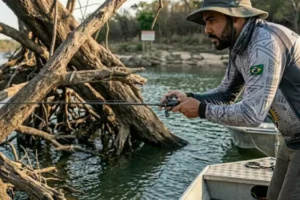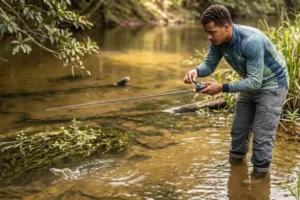
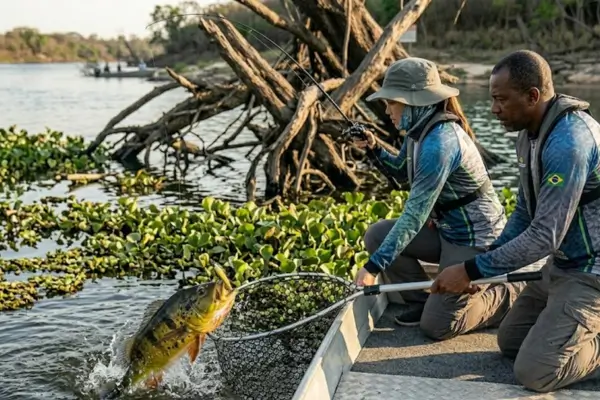
Landing fish in rivers filled with submerged structures requires constant attention, equipment control, and the ability to adapt throughout the entire process. In environments with logs, submerged branches, rocks, and underwater vegetation, the work does not end after the hookset. In many cases, the following moments become the most important for maintaining control of the situation.
After contacting the lure, many species immediately move toward protected areas near natural obstacles. For this reason, proper fish control depends on rod positioning, line management, and the angler’s ability to react quickly to direction changes.
In addition, intelligent use of the boat and continuous environmental reading help reduce difficulties during the landing process.
With practice and constant adjustments, anglers can improve fish control even in extremely structured environments.
How Submerged Structures Influence Fish Behavior After the Hookset
Submerged structures directly affect fish behavior immediately after the hookset.
Logs, roots, submerged branches, and rocks act as natural holding areas, causing many fish to quickly move toward these locations.
This behavior becomes even more noticeable in rivers with large concentrations of obstacles near shorelines or moderate current areas.
Understanding how fish use these structures greatly improves decision-making during the fight.
Anticipating possible direction changes significantly increases control efficiency.
Initial Reaction to Prevent Fish from Reaching Obstacles
The first few seconds after the hookset are often decisive.
A quick reaction helps reduce the chances of the fish reaching submerged branches, rocks, or tighter structures.
At this moment, maintaining continuous pressure on the line is essential for preserving control over fish movement.
Firm but balanced movements usually produce better results than excessively aggressive actions.
Fast initial response also helps guide the fish toward more open areas early in the process.
Rod Positioning to Control Fish Movement
Rod position directly influences fish direction during the fight.
Side movements help alter the line angle and improve fish control in structured environments.
Depending on obstacle placement, small rod angle adjustments may prevent the fish from reaching critical areas.
Maintaining the rod in a balanced position also improves force distribution throughout the fight.
Proper rod control further reduces excessive line instability.
Tension Control to Maintain Contact Without Losing Mobility
Line tension control is one of the most important aspects during fish landing.
Insufficient tension reduces control, while excessive pressure may limit the mobility needed to react to sudden direction changes.
The ideal approach is maintaining constant contact with balanced pressure, allowing quick reactions without compromising movement fluidity.
Continuous tension adjustments significantly improve stability throughout the process.
In rivers filled with obstacles, small tension changes make a major difference.
Using the Line Angle to Guide Fish into Open Water
The line angle is an extremely important tool for moving fish away from structures.
By adjusting rod and boat position, anglers can modify the direction of applied pressure.
This allows the fish to be gradually guided toward more open areas with fewer obstacles.
In many cases, small lateral adjustments are enough to prevent dangerous approaches toward submerged branches and logs.
Line angle control also improves stability during fish movement.
Adjustments During Sudden Direction Changes
Sudden direction changes are common in structured environments.
For this reason, anglers must maintain constant attention to fish behavior throughout the fight.
Quick rod movements and immediate line tension adjustments help follow these changes without losing control.
Anticipating possible movements also greatly improves reaction efficiency.
Continuous adaptation is one of the most important skills in this type of fishing.
Using Boat Movement to Improve Control
The boat can be strategically used to improve fish control.
Small boat movements help alter fighting angles and reduce proximity to submerged obstacles.
In some situations, slowly moving the boat toward open water significantly simplifies the landing process.
Proper positioning also prevents unfavorable line crossings near structures.
Conscious boat use greatly improves control efficiency.
Reducing Slack During Critical Moments
Avoiding excessive slack in the line is essential throughout the entire landing process.
Moments of reduced tension decrease control over fish movement and make rapid responses more difficult.
For this reason, retrieval must continuously follow the fish’s movements.
In critical situations near obstacles, even small amounts of slack may compromise control completely.
Maintaining constant contact greatly improves setup stability.
Final Guidance to the Surface with Greater Control
The final stage of landing also requires attention.
Even near the surface, many fish continue making sudden direction changes.
At this stage, maintaining controlled movements and avoiding excessive acceleration helps preserve balance during the fight.
Gradually guiding the fish closer to the boat also improves stability during the final moments.
Patience during this phase often greatly increases landing efficiency.
Influence of Current on Fish Control
River current directly affects fish movement after the hookset.
In stronger current areas, fish may use water flow to increase direction changes and apply more pressure to the line.
For this reason, adapting rod position and constantly adjusting line tension help maintain greater control.
Understanding current influence significantly improves fish handling in structured rivers.
Equipment Adjustments for Better Control
The equipment used greatly influences landing efficiency.
Rods with fast response characteristics facilitate quick directional adjustments.
Proper line selection helps maintain sensitivity and stability throughout the fight.
Balanced reel settings also allow more efficient pressure control.
A well-balanced setup greatly improves fish handling in areas with natural obstacles.
Importance of Anticipation During the Fight
Anticipating fish movement is an extremely valuable skill.
Observing changes in line direction, movement speed, and behavior near structures helps prepare faster responses.
The earlier the angler identifies the fish’s intended movement, the greater the overall control efficiency tends to become.
This ability develops mainly through practical experience.
Common Mistakes When Landing Fish in Structured Areas
Some mistakes greatly reduce landing efficiency:
- Applying excessive force immediately after the hookset
- Allowing prolonged slack in the line
- Ignoring nearby structure positioning
- Failing to use proper rod angle control
- Making unnecessary abrupt movements
- Failing to reposition the boat when needed
Avoiding these mistakes greatly improves control throughout the landing process.
Strategies for landing fish in rivers with submerged structures require control, observation, and constant adaptation.
The combination of quick reaction, proper rod positioning, line tension control, and intelligent boat use allows anglers to guide fish much more efficiently.
In addition, anticipating direction changes and maintaining continuous contact help reduce difficulties in heavily structured environments.
With practice and continuous refinement, anglers develop greater control during the fight and significantly improve fishing performance in rivers filled with natural obstacles.