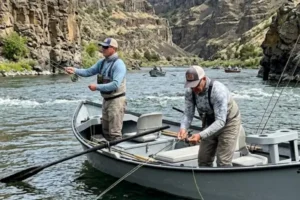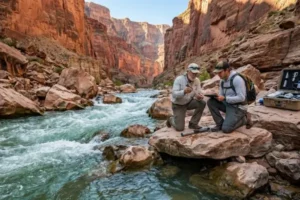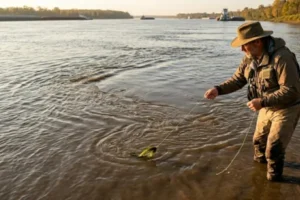
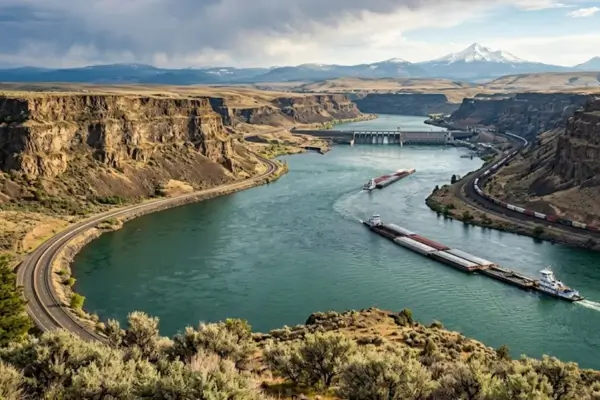
The Columbia River is one of the most important river systems in North America and is especially known for the migration periods of many fish species. During these phases, the behavior of fish schools changes significantly, creating specific movement patterns throughout the river.
Natural structures play a fundamental role in this process. Rapids, shoreline inlets, depth changes, submerged formations, and transition zones directly influence the routes fish use during migration.
For this reason, correctly interpreting these environmental characteristics greatly helps identify more productive areas throughout the migration season.
In addition, species behavior changes according to water conditions, current intensity, and the progression of the migration period, making environmental interpretation a continuous and extremely important process.
Natural Routes Used by Migrating Species
During migration periods, many species follow natural corridors throughout the Columbia River.
These routes usually follow moderate-current areas, channel edges, and regions with stable depth.
Fish also tend to avoid extremely turbulent sections whenever more efficient movement alternatives are available.
Natural routes function as low-energy travel paths, allowing more consistent movement throughout the river system.
Learning to identify these corridors greatly improves overall river interpretation.
Influence of Rapids and Transition Areas on Fish Movement
Rapids directly influence the behavior of migrating fish.
In many situations, migrating species use the edges of faster water sections to maintain stability while continuing their upstream or downstream movement.
Transition zones between strong current and calmer water often concentrate significant activity.
These locations also frequently function as temporary regrouping areas for fish schools.
Migrating fish commonly alternate between active movement and short resting periods in these transition regions.
Submerged Structures That Concentrate Activity During Migration
Submerged structures play an important role during migration periods on the Columbia River.
Large rocks, submerged timber, bottom depressions, and natural formations alter water circulation and create zones of relative stability.
These locations frequently concentrate activity because they provide resting areas and small protected sections against stronger current.
Many structures also accumulate natural food transported by the river flow.
As a result, several species temporarily remain near these regions during migration.
Resting Areas Along Main Migration Corridors
Even during intense migration movements, fish need to alternate travel and energy recovery.
For this reason, resting points along main migration corridors become extremely important.
These areas commonly appear behind natural structures, near depth changes, or in side-current regions with reduced flow.
Resting zones are also often positioned very close to primary migration routes.
This combination allows fish to quickly resume movement whenever necessary.
Relationship Between Depth and Fish School Direction
Depth directly influences fish school positioning and movement direction during migration.
During many periods, migrating species prefer to remain at intermediate depths to balance stability and movement efficiency.
Under stronger light conditions or intense current, many fish move toward deeper regions.
Abrupt depth changes also frequently function as natural references during migration.
Observing these variations greatly helps interpret fish movement throughout the river.
Impact of Water Temperature on Species Distribution
Water temperature has a major influence on species distribution throughout the Columbia River.
During migration periods, small thermal changes can significantly alter movement speed and fish concentration in certain areas.
Regions with more stable temperatures frequently concentrate greater activity.
Some species also seek specific river sections according to changing thermal conditions throughout the season.
Continuous temperature observation greatly improves environmental interpretation.
Temporary Feeding Areas During Migration
Even during migration periods, fish continue feeding at specific times.
For this reason, areas with higher concentrations of natural food frequently attract fish schools temporarily.
These regions commonly appear near current convergences, whirlpool zones, and areas with differentiated water circulation.
Small baitfish and aquatic organisms transported by the current also tend to accumulate in these locations.
As a result, migrating species often remain in these areas for short periods before continuing movement.
Interpretation of Shorelines and Natural Inlets
The shorelines of the Columbia River display wide structural diversity throughout the river system.
Natural inlets, protected areas, and small side bays frequently serve as temporary holding and travel locations.
These regions also usually feature more moderate current compared to the main channel.
Many species use these areas to reorganize fish schools or pause during migration.
Correctly interpreting these formations greatly increases river-reading efficiency.
Adjusting Environmental Interpretation Throughout the Season
The behavior of the Columbia River continuously changes throughout the migration season.
Variations in water level, current intensity, temperature, and light constantly alter species distribution.
For this reason, productive areas at one moment may display completely different behavior weeks later.
Continuous environmental adaptation is essential for following these changes.
Seasonal progression also frequently modifies the routes most commonly used by migrating fish.
Influence of River Flow on Migration Corridor Formation
The flow of the Columbia River directly influences the formation of migration corridors used by fish species.
During periods of stronger current, many fish seek routes with lower hydraulic resistance.
Under more moderate flow conditions, fish schools tend to use wider sections of the river.
Flow changes can also rapidly alter fish distribution throughout the main channels.
How Irregular Bottom Surfaces Affect Movement
The irregular bottom of the Columbia River creates multiple differentiated circulation zones.
Rocks, depressions, and submerged formations alter current speed and create stability zones used by fish.
These surfaces also help direct fish school movement along natural migration corridors.
Learning to interpret these irregularities significantly improves environmental reading.
Importance of Continuous Environmental Observation
During migration periods, river behavior can change rapidly.
For this reason, constant observation of the surface, current flow, and natural movement is extremely important.
Small changes in water coloration, flow speed, or baitfish activity often indicate important changes in fish positioning.
The greater the observation ability, the more efficient environmental interpretation becomes.
Common Mistakes When Reading Natural Structures During Migration
Some mistakes greatly reduce the ability to identify productive areas:
- Ignoring transition zones between currents
- Fishing only in the main channel
- Failing to observe depth changes
- Staying too long in inactive areas
- Ignoring natural resting points
- Overlooking the impact of water temperature
- Failing to adapt interpretation throughout the season
Avoiding these mistakes significantly improves migration behavior interpretation.
Reading natural structures on the Columbia River during migration months requires constant observation, interpretation of water flow, and understanding of fish movement behavior.
The combination of analyzing rapids, identifying resting areas, observing depth changes, and interpreting temporary feeding zones allows anglers to locate far more productive sections throughout the river.
In addition, understanding the influence of temperature, current, and submerged structures helps follow the environmental changes that occur throughout the migration season.
With experience and continuous adaptation, reading the Columbia River becomes increasingly precise, allowing a better understanding of the natural movement patterns of migrating species.