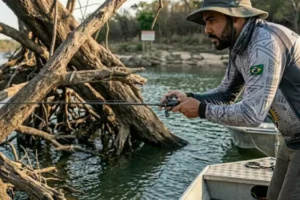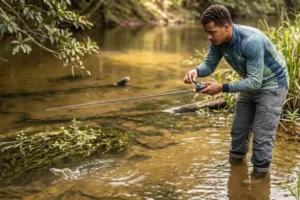
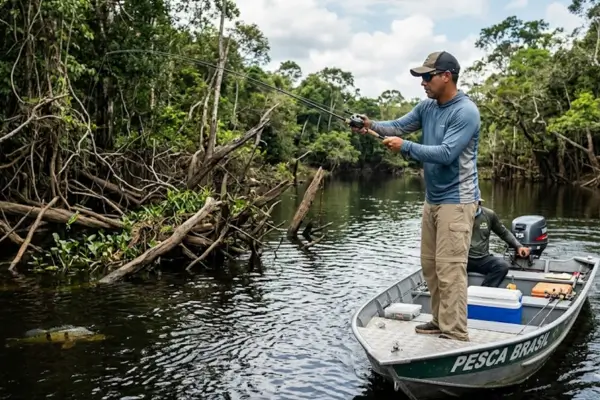
Precise casting in boat fishing in rivers with submerged structures is an essential skill when targeting tucunaré in structured environments. This type of setting requires technical control, as small errors in lure placement can reduce presentation efficiency.
Precision depends not only on casting technique but also on environmental reading, boat positioning, and coordination between equipment and movement. In structured rivers, every detail of the cast directly influences the outcome.
Why Precision Matters in Structured Areas
In areas with natural structures such as logs, submerged branches, and underwater vegetation, casting precision is essential to reach the most productive spots.
Tucunaré often occupy specific positions within these structures, such as edges, shaded zones, and small openings. This requires the lure to be placed carefully into the correct target zone.
A well-placed cast improves presentation efficiency and reduces the need for corrections during retrieval. In many cases, differences of just a few centimeters can influence fish response.
Quick Spot Reading Before Casting
Before casting, a quick reading of the environment is essential. This includes identifying visible structures, current changes, shadows, and possible natural water corridors.
In structured rivers, the surface often indicates what is happening below. Small movements, color changes, or current breaks may suggest submerged obstacles.
This reading helps select the best entry point for the lure and improves casting accuracy. The faster and more efficient this reading is, the more consistent the results tend to be.
Boat Positioning for Better Casting Angles
Boat positioning directly influences casting angles. A well-chosen position makes it easier to access target areas within structures.
Keeping the boat aligned with the target zone allows shorter and more controlled casting trajectories, reducing the need for long or corrective casts.
In structured environments, small adjustments in boat position can significantly improve casting precision. Even minimal movement can completely change the lure entry angle.
Rod Movement Control During Casting
Rod movement must be controlled and consistent to ensure accuracy. Overly aggressive casts can disrupt lure trajectory, especially in areas with nearby obstacles.
A smooth motion helps maintain line stability during the cast and reduces unwanted trajectory variations.
Coordination between applied force, rod direction, and line release is essential to consistently reach the intended target.
Force Adjustment to Avoid Obstacle Contact
Casting force must be adjusted according to distance and the type of structure present in the environment.
Excess force may cause the lure to overshoot the target or enter unwanted areas within the structure. This can reduce presentation efficiency and control.
On the other hand, insufficient force may prevent the lure from reaching the intended zone, especially in areas with current or light wind.
Balancing control and power is essential for maintaining accuracy.
Short Casting Techniques for Restricted Spaces
In areas with limited space between structures, short casting techniques are more effective.
This method allows better control over lure trajectory and improves placement in specific spots, such as small gaps between submerged branches.
Short casts also reduce interference with natural obstacles, resulting in cleaner and more direct presentations.
With practice, this type of casting becomes more consistent and predictable.
How to Direct the Lure to Specific Targets
Directing the lure precisely requires coordination between vision, body positioning, and rod control.
The focus should be on the exact point where the lure is intended to act, not just the general direction of the area.
Small angle adjustments can significantly change the final lure trajectory, especially in short-range casts.
This skill improves through repetition and constant observation of lure behavior on the water.
Synchronization Between Line Release and Lure Trajectory
Synchronization between line release and lure movement is one of the most important factors for accuracy.
If the line is released too early or too late, the trajectory can be affected and the lure may miss the target zone.
Reel control must be smooth, allowing the lure to follow a natural path toward the intended point.
This coordination greatly improves casting efficiency in structured environments.
Repetition and Consistency to Improve Efficiency
Consistent repetition of correct movements is essential for improving casting accuracy over time.
Repeated casts using proper technique help develop muscle memory and better equipment control.
Consistency also helps identify fish response patterns in specific structural areas, improving decision-making during fishing.
Over time, this leads to higher precision and fewer adjustments during use.
Fine Equipment Adjustments for Better Accuracy
Equipment plays a major role in casting precision. Adjustments in reel braking, rod selection, and line type can improve overall control.
A well-tuned system reduces casting variation and improves repeatability.
Rod action also directly affects system response, as does line choice.
These adjustments should be adapted based on structure type and fish behavior in each situation.
Current Influence on Casting Accuracy
River current also affects casting precision. In stronger flow areas, lure trajectory may shift slightly during movement.
This requires adjustments in casting force and angle to compensate for current influence.
In calmer areas, control is easier, allowing more consistent casting repetition.
Understanding this influence helps improve consistency throughout the day.
Situations Where Precise Casting Is Most Important
Precise casting becomes especially important in situations such as:
- Structures with tight gaps between submerged branches
- Shaded areas with specific fish concentration points
- Banks with submerged vegetation near the boat
- Locations with variable current and natural obstacles
- Repeated tucunaré activity zones
In these conditions, casting accuracy directly influences fishing success.
Expanding Efficiency Through Continuous Practice
Continuous practice is one of the most important factors in improving casting precision. The more the angler repeats movements in different conditions, the greater the ability to adapt.
This development allows faster adjustments as environmental conditions change throughout the day.
Over time, casting becomes more natural, consistent, and efficient.
Precise casting in boat fishing in rivers with structured environments is an essential skill for effectively targeting tucunaré. It depends on environmental reading, boat positioning, equipment control, and technical coordination.
When properly executed, casting allows accurate lure placement, improving presentation consistency in structured areas.
Continuous practice combined with fine equipment adjustments and environmental awareness is essential for developing this skill and achieving better results over time.