
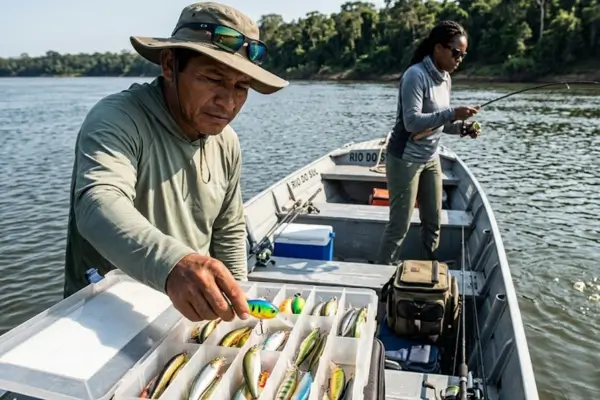
The use of mid-depth lures in boat fishing is a highly effective strategy when fish are distributed in intermediate layers of the water column. This situation is common in river environments with variable depth, moderate current, and submerged structures that directly influence fish behavior.
Mid-depth lures operate in a strategic zone between the surface and the bottom, allowing anglers to target a layer where fish frequently move. To achieve good results, it is essential to understand how this distribution occurs and how to adjust technique, equipment, and retrieve rhythm accordingly.
Understanding Fish Behavior in Intermediate Water Layers
In rivers, fish rarely stay fixed at a single depth level. At many times of the day, they move through intermediate layers where conditions such as temperature, current, and food availability are more balanced.
This intermediate zone works as a constant transition area. Fish move up and down depending on changes in light, water flow, and the presence of submerged structures such as logs, rocks, and aquatic vegetation.
Another important factor is environmental adaptation. In rivers with variable current, fish often use this layer to conserve energy while moving efficiently through the system.
Understanding this behavior helps anglers select the right lure type and adjust working depth more precisely.
When to Prioritize Mid-Depth Lures in Boat Fishing
Mid-depth lures should be prioritized when there are signs of fish activity in the middle water column. This is common in rivers where fish are not clearly concentrated near the surface or bottom.
These lures are also effective when submerged structures create multiple depth levels. In these areas, fish often move between layers depending on conditions.
Another favorable situation is during changes in daylight throughout the day. In these moments, fish may shift to intermediate zones seeking more stable environmental conditions.
Choosing the right timing significantly increases presentation efficiency.
Shapes and Actions That Improve Consistency
The lure shape directly influences its action during retrieval. Longer, slimmer models tend to produce smoother and more continuous movement, while compact designs create stronger vibrations.
This difference allows adaptation to fish behavior in each situation. During higher activity periods, stronger actions may be more effective. In calmer conditions, subtle movements often perform better.
Consistent action is essential to keep the lure stable within the intermediate layer.
Lure design also affects its ability to maintain balance under changing current conditions.
Working Depth and Water Column Adjustment
Working depth is one of the most important factors when using mid-depth lures. It determines which layer of the water column the lure will occupy during retrieval.
This control can be adjusted through retrieve speed, line type, and casting angle.
Maintaining the lure in the intermediate layer requires constant attention, since small variations can change its position in the water column.
In environments with variable current, this control becomes even more important.
Influence of Buoyancy on Lure Performance
Lure buoyancy defines its natural tendency to stay at a certain depth level. Neutral buoyancy models tend to remain longer in the intermediate layer.
Floating or slowly sinking models may require adjustments in retrieve technique to maintain the desired depth.
This factor should be selected according to river type and average fishing depth.
The combination of buoyancy and retrieve rhythm is essential for keeping the lure within the target zone.
Color Selection in Different Visibility Conditions
Water visibility directly affects lure color selection. In clearer water, natural tones often perform better because they blend with the environment.
In more turbid water, higher contrast colors improve visibility within the water column.
Light conditions also play an important role. On cloudy days, brighter colors may be more visible, while in clear conditions, more subtle tones often work better.
Color selection should always balance visibility and natural appearance.
Retrieve Rhythm to Maintain Ideal Depth
Retrieve speed is one of the main factors for keeping mid-depth lures in the correct layer. A fast retrieve may lift the lure too close to the surface, while a slow retrieve may bring it closer to the bottom.
The ideal approach is a balanced rhythm that keeps the lure stable in the intermediate zone.
Small variations in speed during retrieval can also simulate natural movement, increasing effectiveness.
This control helps maintain consistency in different current conditions.
Equipment Adjustments for Better Lure Response
Lure performance also depends on equipment setup. Rod, reel, and line selection directly influence lure control.
Fast-action rods provide better sensitivity and improved control during lure movement. Thinner lines can enhance responsiveness and reduce water resistance.
The correct combination of components helps keep the lure stable in the water column.
Overall balance improves control across different depths.
Interaction Between Current and Lure Movement
River current directly affects mid-depth lure behavior. In stronger flow areas, the lure may drift more easily, requiring constant retrieve adjustments.
In calmer zones, depth control tends to be more stable.
Understanding this interaction helps refine technique and maintain lure position in the intermediate layer even under changing conditions.
Situations Where Mid-Depth Lures Stand Out
Mid-depth lures perform best when fish are distributed across multiple layers of the water column.
They are especially effective near submerged structures where fish move between different depths.
They also work well in rivers with moderate current, where the lure can maintain consistent action.
Another favorable situation is in transition zones between shallow and deep areas.
Expanding Strategy in River Environments
Mid-depth lures allow a broader approach in dynamic river environments. Instead of focusing only on surface or bottom zones, anglers can target a more active intermediate layer.
This increases the chances of interaction with fish that move continuously between depths.
With proper adjustments, the same lure can be used across multiple situations within the same environment.
Mid-depth lures are an essential tool for boat fishing in rivers where fish occupy intermediate water layers. Their effectiveness depends on correct lure selection, proper depth control, and adaptation to environmental conditions.
The combination of technique, equipment, and reading fish behavior is key to maintaining the lure in the ideal water column zone.
When properly applied, these lures offer a versatile and efficient approach to exploring different river layers consistently and effectively.