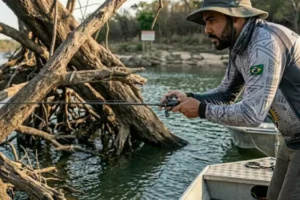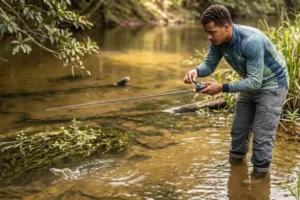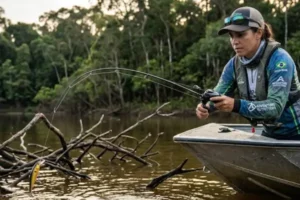
Depth control of lures is one of the most important factors in boat fishing in rivers where dorado are present in deep areas. This type of environment requires precision in how the lure is positioned within the water column, since small variations can significantly affect presentation efficiency.
In deep rivers, dorado often move between different water layers depending on current flow, underwater structure, and natural activity zones. Because of this, maintaining the lure at the correct depth throughout the presentation is essential for improving results.
This control depends not only on lure selection but also on sink time, retrieval rhythm, line angle, and the ability to adapt to changing conditions.
Dorado Positioning in Deep Areas
In deep areas, dorado tend to position themselves in strategic zones where current creates natural movement corridors. These spots may be near the bottom, in mid-water layers, or closer to the surface depending on river conditions.
In many situations, fish move between different depths throughout the day. This behavior makes it necessary to continuously adjust lure depth during presentation.
Changes in riverbed structure, current speed, and underwater features all influence where fish are likely to position themselves.
Reading the Spot Before Setting Working Depth
Reading the fishing spot is the first step in defining lure working depth. This includes observing current behavior, water depth, and possible underwater variations.
In deep rivers, small surface changes often indicate important differences below the water. These clues help determine the most effective working layer for the lure.
A proper reading reduces the need for constant adjustments during retrieval and improves consistency across different locations.
Lure Sink Time After the Cast
Lure sink time after the cast is one of the key elements in depth control. This determines the initial working layer of the lure.
Heavier lures reach deeper layers quickly, while lighter lures stay longer in upper zones.
Controlling this timing allows anglers to better match the target depth zone. In many cases, counting a few seconds before starting retrieval helps reach the desired layer.
Retrieval Control to Maintain the Ideal Depth Range
Retrieval control is essential for keeping the lure within the desired depth range during the entire presentation.
Faster retrieval tends to lift the lure toward shallower layers, while slower retrieval keeps it deeper.
Consistent movement also helps maintain lure stability throughout the retrieve, avoiding unwanted depth changes.
This continuous control is necessary to keep the lure within the active fish zone.
Line Angle Adjustment for Better Water Penetration
The line angle during retrieval directly affects lure depth.
A steeper angle helps the lure penetrate deeper layers more effectively, while a flatter angle keeps it in mid-water levels.
This adjustment can be made by changing rod position during retrieval.
Even small angle variations can significantly change how the lure behaves in the water column.
Using Pauses to Reach Deeper Layers
Pauses during lure working are an important tool for controlling depth.
When movement stops, the lure often sinks again depending on its buoyancy characteristics.
These pauses can be used strategically to vary depth within a single presentation.
In deep environments, this technique helps explore multiple layers of the water column more effectively.
Preventing the Lure from Rising During Retrieval
Preventing the lure from rising during retrieval is essential for maintaining consistent depth.
Fast or continuous movement can cause the lure to gradually move toward shallower layers.
Controlling retrieval rhythm helps keep the lure within the intended zone for longer periods.
Rod position and line tension also play a significant role in maintaining depth stability.
Adjusting Depth According to Fish Response
Fish response should be observed continuously to adjust lure depth.
At times, fish may be more active in mid-water layers, while in other moments they concentrate in deeper zones.
This variation requires constant adaptation during lure working.
The ability to quickly adjust depth increases presentation efficiency in different river conditions.
Current Influence on Lure Position in the Active Zone
River current directly affects how long the lure stays in the active zone.
In stronger current areas, the lure may shift between different water layers more easily.
This requires constant adjustments in line angle and retrieval rhythm.
In calmer areas, depth control tends to be more stable and predictable, allowing more consistent presentations.
Depth Variation Throughout the Day
In deep rivers, fish depth positioning can change throughout the day.
Changes in light conditions, water temperature, and current intensity can influence these shifts.
For this reason, continuous adjustment of lure depth is necessary during fishing.
This flexibility improves efficiency across different time periods.
Equipment Adjustments for Better Depth Control
Equipment also plays an important role in depth control. Lure type, line choice, and rod selection all influence how the lure behaves underwater.
Thinner lines generally offer less resistance, improving depth control accuracy.
Different buoyancy levels in lures require specific adjustments in sink time and retrieval rhythm.
These adjustments help maintain more consistent presentations.
Common Mistakes in Depth Control
Some mistakes can reduce efficiency when controlling lure depth in deep rivers:
- Starting retrieval without considering sink time
- Keeping a constant retrieval rhythm without variation
- Ignoring current changes during presentation
- Not observing fish response in the water column
- Lack of line angle adjustments during retrieval
Avoiding these mistakes helps maintain more effective and controlled presentations.
Expanding Efficiency in Deep Water Environments
Depth control in deep river environments requires practice, observation, and continuous adaptation.
Each location may present different characteristics, requiring specific adjustments during lure working.
Over time, environmental reading becomes more accurate, allowing better control over presentation depth.
Depth control of lures in boat fishing in rivers with dorado in deep areas is one of the most important factors for improving presentation efficiency.
It depends on spot reading, sink time control, retrieval rhythm, line angle, and continuous adaptation to fish behavior.
When applied correctly, this control allows precise exploration of different water layers, improving consistency of interactions and overall fishing performance throughout navigation.