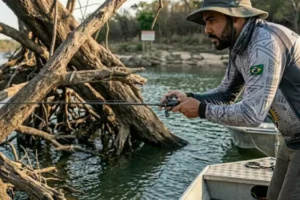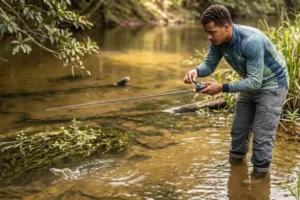
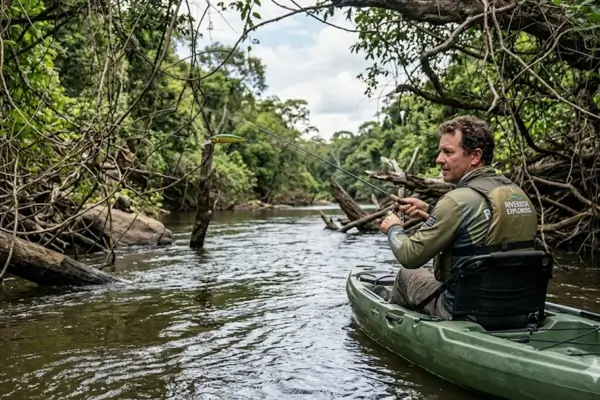
Fishing in rivers with banks covered by dense vegetation requires constant adaptation of casting techniques. Low branches, exposed roots, leaning logs, and foliage hanging over the water completely change how the lure must be presented.
In this type of environment, precision and control become more important than casting distance. In many cases, the best spots are hidden within small natural corridors between the vegetation, requiring short, low, and highly controlled casts.
In addition, boat positioning, environmental reading, and trajectory selection directly influence presentation efficiency. Small adjustments in casting technique can significantly improve performance near the riverbanks.
How Dense Vegetation Redefines Casting Lines
In rivers with dense vegetation, traditional casting lines often become ineffective. The available space for lure passage becomes limited, forcing anglers to adapt height, direction, and casting force.
Vegetation creates narrow corridors and restricted angles, making wide rod movements difficult. Instead of high and long casts, low and controlled trajectories become much more efficient.
Each section of the riverbank may present different characteristics. In some areas, branches extend horizontally over the water. In others, roots and logs narrow the available space even more.
This variation requires constant observation and quick adaptation throughout navigation.
Reading Natural Corridors Between Branches and Foliage
Before making any cast, it is important to analyze the environment and identify natural corridors between branches, leaves, and structures near the water.
These corridors function as open paths for the lure to travel through. In many cases, small openings that seem almost invisible allow access to highly productive spots close to the bank.
Visual reading should consider not only the entry point of the lure but also its trajectory during retrieval.
Many times, a corridor may appear open at first but becomes restricted further ahead due to submerged branches or leaning vegetation.
The more detailed the reading, the greater the casting precision.
Boat Positioning to Create Favorable Angles
Boat positioning directly influences casting quality in closed environments.
An improper position may completely limit rod movement or create an unfavorable angle for lure entry.
Small lateral adjustments often improve casting alignment and make it easier for the lure to pass through natural corridors.
The ideal approach is to position the boat so the cast naturally follows the available open space between obstacles.
Maintaining some distance from the bank also helps expand visibility and improve trajectory control.
Height and Trajectory Control to Avoid Contact with Vegetation
In areas with dense vegetation, controlling casting height is essential.
High casts increase the chances of contact with branches and leaves, reducing accuracy and making lure presentation more difficult.
For this reason, lower and more direct trajectories tend to produce better results.
This type of cast requires coordination between rod movement, casting speed, and line release.
The smoother and more controlled the movement, the greater the ability to place the lure into restricted spaces.
Sidearm Casts to Access Protected Spots
Sidearm casts are extremely useful in rivers with vegetation-covered banks.
This technique allows the lure to travel close to the water surface, making it easier to pass under low branches and leaning structures.
In addition, sidearm casting provides excellent directional control, making it ideal for working narrow spaces between obstacles.
In areas where vertical rod movement is limited, this casting style becomes even more important.
With practice, anglers can execute highly precise casts even in heavily structured environments.
Using Short Casts to Work Tight Spaces
In environments with many natural obstacles, short casts usually produce better results than long-distance casts.
This type of presentation offers greater trajectory control and allows quick adjustments during execution.
Short casts also make it easier to target small specific spots between brush and vegetation.
Another advantage is the ability to repeat casts from different angles without requiring major boat repositioning.
This controlled repetition improves efficiency throughout the fishing session.
Adjusting Casting Force for Better Lure Placement
The force applied during the cast must match the available space and distance to the target.
Excessive force may cause the lure to overshoot the intended corridor or contact nearby branches.
On the other hand, insufficient force may prevent the lure from reaching the target area.
The balance between smoothness and precision is essential for placing the lure effectively in dense vegetation environments.
This adjustment improves through practice and continuous observation of lure behavior during casts.
Fast Retrieval to Keep the Lure in the Active Zone
Once the lure enters the desired area, retrieval should begin efficiently to keep the presentation within the active zone.
Near vegetation, open space is often limited. As a result, the lure remains in the productive area for only a short time before encountering additional obstacles.
Controlling retrieval speed helps maintain stability throughout the lure’s path.
It is also important to adjust retrieval rhythm according to water behavior and surface activity.
Strategic Repositioning After Each Attempt
In rivers with dense vegetation, constant boat repositioning is part of the overall strategy.
After several casts, small position changes may reveal new natural corridors or significantly improve the lure entry angle.
This repositioning also helps explore different depths and trajectories near the banks.
Often, moving only a few feet completely changes presentation efficiency.
The ability to reposition quickly greatly increases the effectiveness of fishing structured areas.
Refining Precision Through Repeated Casting Sequences
Precision in closed environments improves through continuous repetition.
Casting sequences help anglers adjust height, force, and direction according to changing environmental conditions.
Over time, the body naturally recognizes the movements required for each situation.
This refinement reduces trajectory errors and improves overall presentation consistency.
Continuous practice also improves spatial awareness and environmental reading skills.
Current Influence on Lure Trajectory
River current directly affects lure behavior after the cast.
Even near the banks, small variations in water flow can significantly alter lure trajectory during retrieval.
For this reason, it is important to consider not only the lure entry point but also how it will move throughout the retrieve.
Understanding current influence helps anglers anticipate adjustments in retrieval rhythm and rod positioning.
Equipment Adjustments for Better Performance
The equipment used has a major influence on casting precision in dense vegetation areas.
Fast-action rods facilitate short and accurate movements, while proper line selection improves trajectory control.
Reel adjustments should also be tuned for smooth casting in restricted spaces.
A balanced setup reduces casting variations and improves movement consistency throughout the day.
Mental Control and Execution Rhythm
In tight environments, the desire to reach difficult spots can negatively affect casting execution.
Maintaining a controlled rhythm and performing each cast calmly helps improve accuracy.
Focusing on the chosen corridor and trajectory significantly increases efficiency.
With practice, anglers develop greater confidence and control during lure presentation.
Common Mistakes in Dense Vegetation Areas
Some mistakes greatly reduce casting efficiency in closed environments:
- Using excessive force in short spaces
- Ignoring natural corridors between branches
- Repeating the same casting angle every time
- Positioning the boat without considering available trajectories
- Working the lure too quickly near vegetation
- Performing abrupt rod movements in restricted spaces
Avoiding these mistakes greatly improves presentation consistency.
Casting strategies in rivers with dense vegetation along the banks require precision, adaptability, and constant environmental reading. Control of trajectory, casting height, and boat positioning are fundamental factors for achieving better results.
When these techniques are properly applied, it becomes possible to explore narrow natural corridors and present the lure efficiently even in heavily structured areas.
Continuous practice combined with environmental observation and refinement of movements is essential for improving precision and consistency throughout the fishing experience.