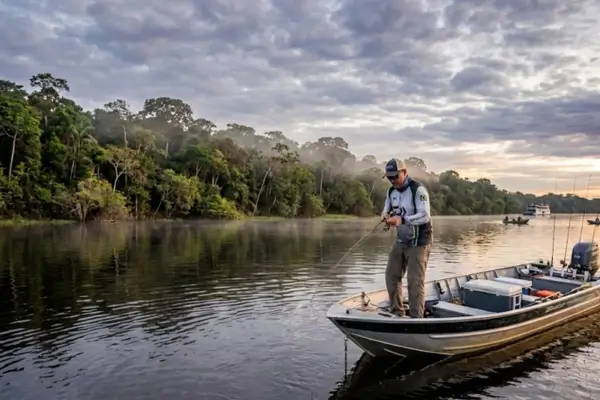
The Rio Negro is one of the best-known rivers in the Amazon region and is especially recognized for the dark coloration of its waters. This characteristic creates a very unique environment where light conditions, visibility, and water circulation directly influence fish behavior.
The natural composition of the water, rich in dissolved organic matter, significantly reduces transparency throughout many sections of the river. As a result, fish develop movement and feeding patterns that are highly adapted to low-visibility conditions.
In addition, factors such as current, depth, submerged structures, and weather changes strongly influence species distribution along the Rio Negro.
For this reason, understanding how this environment functions is essential for correctly interpreting fish behavior in dark-water conditions.
Characteristics of the Rio Negro Under Dark-Water Conditions
The waters of the Rio Negro display naturally dark coloration due to the large amount of dissolved organic matter originating from forest vegetation.
This characteristic reduces light penetration throughout much of the aquatic environment.
Submerged visibility also varies considerably depending on depth, sunlight intensity, and water movement.
In many sections, even during brighter periods, visibility remains limited below the surface.
These conditions create an environment that differs greatly from clear-water or muddy-water rivers.
Low Visibility and Its Effects on Fish Activity
Low visibility directly influences species behavior in the Rio Negro.
Many fish rely less on vision to locate food and identify nearby movement.
Movement patterns also tend to become more cautious in certain river sections.
Limited visibility additionally changes the peak activity periods of some species, especially in shallower regions.
As a result, fish develop specific navigation and feeding strategies for dark-water environments.
Dependence on Vibration and Sound for Locating Prey
In low-visibility environments, vibration and sound become extremely important for fish.
Many species use changes in water movement to identify the presence of small organisms and potential feeding opportunities.
Subtle changes in pressure and water displacement also help fish interpret their surroundings.
This sensory capability makes areas with differentiated water circulation especially important in the Rio Negro.
Convergence Zones in Areas Where Currents Meet
Zones where different currents meet frequently concentrate significant activity in the Rio Negro.
These regions create varied water circulation and accumulate natural food transported by the flow.
Changes in current intensity also help fish locate more favorable holding and travel areas.
Many species use these convergence zones as natural travel corridors throughout the river.
Submerged Structures as Natural Reference Points
Submerged structures play a fundamental role in low-visibility environments.
Submerged timber, roots, branches, and natural bottom formations function as reference points for many species.
These structures also alter water circulation and create stability zones heavily used by fish.
Many aquatic organisms remain close to these regions as well, increasing biological concentration around the structures.
Influence of Water Coloration on Feeding Strategy
The dark coloration of the water significantly alters the feeding strategies of Rio Negro species.
Many fish begin using shorter-range approaches and increased vibration detection to locate food.
Water movement also becomes an extremely important factor for identifying feeding opportunities.
At many times, predatory species remain close to structures and natural corridors while waiting for small organisms to pass.
Shoreline Areas with Vegetation and Greater Life Concentration
The shorelines of the Rio Negro frequently contain dense partially submerged vegetation.
These regions create protected environments with moderate circulation and high availability of organic material.
Small aquatic organisms and baitfish also commonly remain close to these areas.
As a result, vegetated shorelines frequently concentrate intense biological activity throughout the river.
Fish Adaptation to Reduced Visual Signals
Fish species in the Rio Negro display strong adaptation to low-visibility conditions.
Many species have developed greater sensitivity to vibration, water movement, and environmental changes around them.
Movement patterns are also commonly adjusted according to current intensity and depth.
This adaptation allows fish to use the environment extremely efficiently even under limited visibility conditions.
Interpreting Depth in Low-Visibility Environments
Depth strongly influences species behavior in dark-water environments.
In deeper regions, light penetration decreases even more, altering fish movement and positioning.
Gradual depth changes also frequently create natural travel corridors.
Many species alternate between deep and intermediate holding areas depending on current and light conditions.
Adjusting Environmental Interpretation in Different Weather Conditions
Weather conditions significantly alter the behavior of the Rio Negro.
Clearer days partially increase light penetration in certain river sections.
Cloudy periods further reduce submerged light levels.
Rain, wind, and water movement also modify circulation and directly influence species activity.
Continuously adapting environmental interpretation greatly improves river reading.
Influence of Current on Species Distribution
Current plays an extremely important role in the dark waters of the Rio Negro.
Many species use water movement as their primary reference for travel and food location.
Changes in current intensity also create stability zones frequently used by fish.
Understanding flow behavior significantly improves environmental interpretation.
How Bottom Structure Affects Fish Behavior
The bottom of the Rio Negro displays great structural diversity.
Areas with submerged timber, roots, branches, and natural depressions create favorable holding environments for many species.
These formations also alter water circulation and help concentrate small aquatic organisms.
Many fish use these structures as references during movement throughout the river.
Importance of Transition Areas
Transitions between different depths, currents, and structures are among the most important locations in the Rio Negro.
These regions frequently concentrate significant species movement related to stability and feeding.
Transition corridors also help fish navigate within low-visibility environments.
Correctly interpreting these areas greatly improves river reading.
Species Adaptation to Environmental Conditions
Fish species in the Rio Negro demonstrate a high capacity for adaptation to dark-water conditions.
Throughout the day, different species adjust movement, depth, and behavior according to changes in current and light conditions.
Some species make greater use of vegetated shorelines, while others remain closer to submerged structures and deeper areas.
This continuous adaptation directly influences species distribution throughout the river.
Common Mistakes When Interpreting the Rio Negro
Some mistakes greatly reduce the ability to properly interpret the environment:
- Ignoring the influence of low visibility
- Fishing far from submerged structures
- Failing to observe current changes
- Overlooking vegetated shoreline areas
- Ignoring convergence zones
- Failing to adapt interpretation according to weather conditions
- Focusing only on open-water areas
Avoiding these mistakes significantly improves interpretation of species behavior.
The Rio Negro presents an extremely unique environment because of the characteristics of its dark waters.
The combination of low visibility, differentiated circulation, submerged structures, shoreline vegetation, and depth changes directly influences fish behavior and species distribution throughout the river.
Understanding the importance of vibration, current flow, and convergence zones also greatly improves environmental interpretation.
With continuous observation and constant adaptation, reading the Rio Negro becomes increasingly precise, allowing a deeper understanding of the dynamics of this important Amazon river system.