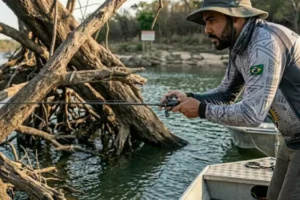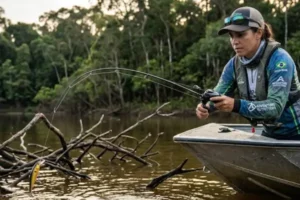
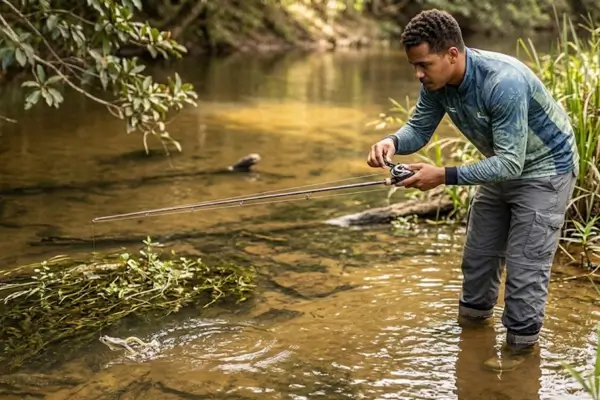
Fishing for trahira in shallow waters requires constant attention to lure retrieval rhythm. In low-depth environments, every movement of the presentation becomes more noticeable, making speed control a key factor for improving fishing efficiency.
Trahira often respond differently depending on lure movement, environmental conditions, and activity levels throughout the day. Because of this, varying retrieval speed and adapting rhythm according to each situation can significantly improve presentation quality.
In shallow rivers, small adjustments in lure action directly affect how long the lure stays in the active zone and how it moves near natural structures.
Trahira Response to Different Movement Rhythms
Trahira usually react differently depending on the retrieval rhythm applied to the lure.
At certain times, slow and continuous movements generate more interest, especially in calm water areas or near dense vegetation. In other situations, sudden speed changes attract more attention and make the presentation stand out.
This behavioral variation requires constant observation and adaptability throughout the fishing session.
Understanding how trahira respond to different rhythms is essential for finding the most effective presentation in each environment.
Reading the Environment Before Defining Retrieval Style
Before starting the retrieve, it is important to observe the environmental conditions.
Areas with floating vegetation, submerged branches, incoming water flow, or small natural corridors directly influence how the lure should be worked.
In tighter areas, controlled retrieval usually produces better results. In open water sections, it becomes easier to vary speed and explore different movement patterns.
Proper environmental reading helps define the most effective rhythm from the very first casts.
Slow Retrieval to Stimulate Movement in Calm Areas
In areas with minimal water movement, slow retrieval is often highly effective.
This rhythm allows the lure to remain longer inside the active zone, increasing presentation visibility.
Smooth movements also improve trajectory control in shallow water.
Slow retrieval works especially well near vegetation, where trahira often position themselves.
Speed Variations to Trigger Instinctive Reactions
Changing retrieval speed during presentation is an important technique for creating a more dynamic lure action.
Quick transitions between slow movement and short accelerations create variations that make the lure stand out underwater.
This technique can be especially effective when fish follow the lure without showing strong activity.
Speed variation creates less predictable and more natural movement patterns.
Using Rod Twitches to Create Irregular Movement
Rod twitches are essential for adding irregularity to lure action.
Short and controlled rod movements change lure direction and movement behavior, creating a more dynamic presentation.
In shallow waters, these directional changes become even more noticeable, making lure action more attractive.
The combination of retrieval and subtle rod twitches allows anglers to explore multiple presentation styles during the same cast.
Strategic Pauses to Increase Trahira Interest
Pauses are part of the retrieval rhythm and can greatly improve presentation efficiency.
When the lure temporarily stops moving, it creates a behavioral change that often increases fish interest.
In shallow waters, short pauses near vegetation or natural structures tend to work very well.
Pauses also help keep the lure longer inside productive zones.
Continuous Rhythm in Areas with Lower Fishing Pressure
In less explored areas, continuous retrieval can produce excellent results.
In these locations, trahira often respond well to stable and linear presentations, especially when the lure maintains consistent movement.
Continuous retrieval also makes it easier to control depth and trajectory in shallow waters.
Even so, small variations throughout the retrieve remain important for creating more natural presentations.
Adjustments Based on Fish Activity Throughout the Day
Trahira activity may change significantly throughout the day, requiring retrieval rhythm adjustments.
During periods of higher activity, faster and more dynamic retrieves may produce better results.
In calmer periods, slower rhythms and more frequent pauses usually improve presentation efficiency.
Observing fish response during the first casts helps define the best pattern for each situation.
Combining Retrieval Rhythm and Lure Positioning
Retrieval rhythm should always work together with proper lure positioning within the environment.
Simply varying speed is not enough if the lure remains far from productive zones.
Keeping the lure close to vegetation, edges, and natural corridors significantly improves presentation efficiency.
Controlling lure trajectory during retrieval also helps extend the lure’s time inside the active zone.
Fine-Tuning the Ideal Rhythm Based on Initial Responses
The first responses observed during fishing are extremely important for refining the ideal rhythm.
Small water movements, fish approaches, or changes in behavior near the lure indicate how fish are reacting to the presentation.
Based on these responses, anglers can speed up, slow down, or add strategic pauses during the next casts.
This continuous adjustment process greatly improves consistency throughout the fishing session.
Influence of Temperature and Light Conditions on Retrieval Rhythm
In shallow rivers, factors such as sunlight intensity and water temperature directly influence trahira behavior.
During brighter periods, more controlled presentations often work better in shaded areas near vegetation.
In lower-light conditions, more active rhythms may improve lure visibility underwater.
Adapting retrieval style according to these conditions improves overall presentation efficiency.
Equipment Adjustments for Better Retrieval Control
The equipment used directly influences retrieval rhythm control.
More sensitive rods make it easier to execute subtle rod twitches and improve perception of lure movement.
Balanced reels help maintain consistent retrieval speed throughout the presentation.
Proper line selection also contributes to better trajectory control in shallow waters.
Common Mistakes in Retrieval Rhythm
Some mistakes greatly reduce presentation efficiency in shallow rivers:
- Working the lure at the same speed during the entire retrieve
- Ignoring pauses during presentation
- Making overly aggressive movements in shallow water
- Failing to adapt rhythm according to the environment
- Retrieving too quickly near vegetation
- Repeating the same movement pattern throughout the fishing session
Avoiding these mistakes helps create more natural and effective presentations.
Retrieval rhythms play a fundamental role in trahira fishing in shallow waters. The combination of speed, pauses, rod twitches, and environmental reading directly influences presentation efficiency.
Constantly adapting rhythm according to fish response and environmental conditions allows anglers to better explore every section of the river.
With practice and continuous observation, it becomes possible to develop more natural, controlled, and consistent presentations throughout the fishing experience.