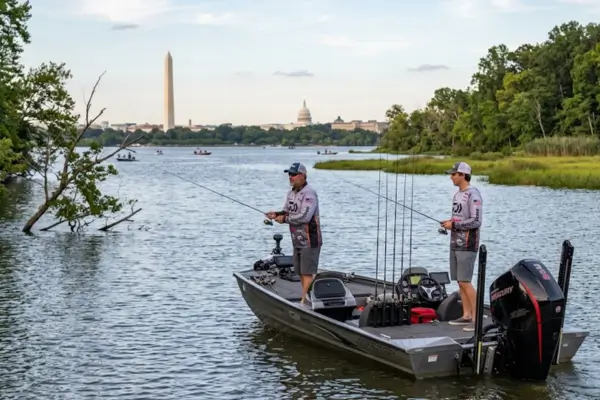
The Potomac River features many sections marked by strong shoreline vegetation, natural fallen branches, exposed roots, and floating plant cover. These environments create highly dynamic conditions that directly influence water circulation, natural food distribution, and the behavior of predatory species.
In addition, the combination of shade, submerged structures, and narrow circulation corridors transforms many sectors of the river into highly productive and complex environments. Small changes in light conditions, depth, and water movement can significantly alter species positioning throughout the day.
Understanding the characteristics of these vegetated sections of the Potomac River requires careful observation of environmental structure and constant interpretation of the interactions between current, vegetation cover, and fish movement.
The Dense Shoreline Vegetation of the Potomac River
In many sections of the Potomac River, shoreline vegetation forms extensive bands along the banks.
Trees leaning over the water, dense shrubs, partially exposed roots, and aquatic vegetation create highly structured environments.
These areas also partially reduce direct sunlight exposure and help create differentiated circulation zones.
Vegetation directly influences the thermal stability of shallow shoreline regions as well.
Formation of Shelter Zones Between Roots and Natural Fallen Branches
Submerged roots and natural fallen branches create countless shelter points throughout the Potomac River.
These structures partially interrupt water flow and form small stability zones close to the shoreline.
Many aquatic organisms also remain close to these formations, increasing biological activity in these regions.
Various species use these environments as temporary holding areas and movement corridors.
Influence of Vegetation Shade on Predatory Species Activity
The shade created by shoreline vegetation strongly influences the behavior of predatory species.
During periods of stronger sunlight, many species seek shaded regions close to fallen branches, roots, and dense vegetation.
These areas also frequently provide more stable temperatures and reduced visual exposure.
The combination of shade and moderate circulation creates highly favorable environments for fish movement throughout the day.
Natural Corridors Created Between Dense Vegetation Areas
Vegetation along the Potomac River frequently forms natural corridors between more enclosed sections.
These corridors function as movement routes used by species along the shorelines.
Small openings between vegetation, fallen branches, and submerged structures also create natural water circulation paths.
Many fish use these regions for continuous movement between open zones and protected areas.
Fish Concentration Along Transition Edges Between Bright and Shaded Areas
The edges where illuminated areas meet shaded regions are among the most important locations on the Potomac River.
These transitions create rapid changes in light intensity and temperature throughout the water.
Small aquatic organisms also frequently concentrate within these intermediate regions.
As a result, many predatory species remain close to these transition zones during different periods of the day.
Submerged Structures Hidden by Vegetation and Their Impact on the Ecosystem
A large portion of the Potomac River’s submerged structures remains partially hidden beneath shoreline vegetation.
Logs, roots, rocks, and natural contours are often covered by surface vegetation.
These structures also modify water circulation and create small stability zones around obstacles.
Such environments help concentrate natural food and small aquatic organisms as well.
Predator Movement in Low-Visibility Areas
In regions with dense vegetation, visibility often becomes more limited.
As a result, many predatory species rely more heavily on vibration perception, water displacement, and movement around structures.
Reduced circulation within some vegetated areas also favors more discreet movement along the shorelines.
These characteristics make fish behavior significantly different compared to open-water sections of the river.
Interaction Between Floating Vegetation and Feeding Zones
Floating vegetation plays an important role in many sections of the Potomac River.
Aquatic plants accumulated on the surface help create shaded areas and softer circulation zones.
Small organisms also frequently remain close to these vegetation formations.
As a result, many species use these regions as feeding and movement zones throughout the river.
Fish Distribution Along Irregular Shorelines
The shorelines of the Potomac River display considerable structural diversity.
Side inlets, small indentations, leaning trees, and natural embankments create multiple microenvironments throughout the river.
These irregularities also directly alter water circulation and the formation of shaded zones.
Many species use these areas for temporary holding and continuous movement.
Adjusting Environmental Interpretation Under Heavy Vegetation Cover
Correct interpretation of the Potomac River requires constant adaptation in areas with intense vegetation.
Changes in light, water circulation, and vegetation movement continuously alter species behavior.
Small variations in depth and openings between fallen branches also frequently create highly productive environments.
Carefully observing these changes greatly improves environmental interpretation.
Influence of Current in Vegetated Areas
Even in heavily vegetated regions, current continues playing a strong role in fish behavior.
Vegetation partially modifies water speed and creates small reduced-flow zones near the shorelines.
These alterations also help concentrate natural food in certain locations.
Many species use these regions as movement routes throughout the river.
How Vegetation Modifies Water Temperature
Shoreline vegetation helps reduce direct sunlight exposure in many sections of the Potomac River.
As a result, shoreline regions frequently maintain more stable temperatures compared to open-water areas.
Shade projected over the water also creates highly favorable microenvironments during periods of stronger sunlight.
These thermal differences directly influence species distribution.
Importance of Transition Areas on the Potomac River
Transition zones are among the most important environments on the Potomac River.
Regions where dense vegetation meets open areas frequently display intense species movement.
These zones also combine shade, moderate circulation, and varying depth levels.
As a result, many fish use these environments as natural travel corridors.
Species Adaptation to Vegetation Cover
Fish species in the Potomac River demonstrate a strong ability to adapt to heavily vegetated areas.
Some species remain close to submerged branches and roots, while others use more open corridors between structures.
Species movement also varies considerably according to light intensity, water circulation, and vegetation density.
This continuous adaptation directly influences river dynamics.
Common Mistakes When Interpreting Vegetated Areas
Some mistakes greatly reduce the ability to correctly interpret vegetated sections of the Potomac River:
- Ignoring natural shade areas
- Fishing only open-water regions
- Failing to observe corridors between vegetation
- Overlooking structures hidden beneath vegetation cover
- Ignoring transitions between bright and shaded areas
- Failing to adapt interpretation according to vegetation density
- Staying too far from structured shorelines
Avoiding these mistakes significantly improves environmental interpretation.
The vegetated sections of the Potomac River offer highly rich and dynamic environments formed by the interaction between shoreline vegetation, submerged structures, shade, and water circulation.
Transition zones, natural corridors, and regions close to roots and fallen branches directly influence the movement and distribution of predatory species throughout the river.
Understanding how vegetation alters light, temperature, and water flow also allows much more accurate environmental interpretation.
With continuous observation and constant adaptation, reading the vegetated sections of the Potomac River becomes increasingly effective, allowing a deeper understanding of the dynamics of this important North American river system.