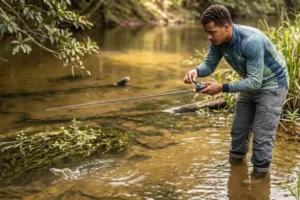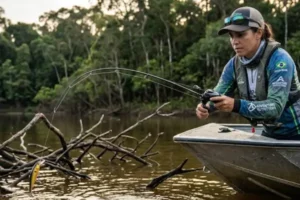
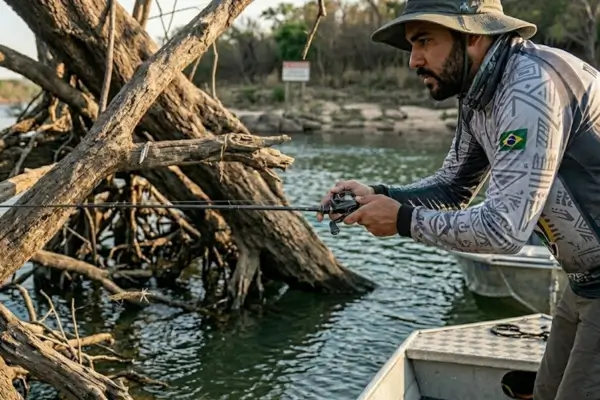
Casting control is an essential skill for fishing near logs, submerged branches, and natural underwater structures. In environments filled with obstacles, precision becomes more important than simply achieving long casting distance.
In these situations, small mistakes in direction, force, or trajectory may cause the lure to hit branches, lose presentation efficiency, or completely miss the intended target area.
For this reason, developing control over casting movements helps not only improve lure presentation, but also increase efficiency when targeting productive spots.
In addition, constant practice allows anglers to quickly adapt their technique according to available space, structure type, and boat positioning.
How Logs and Submerged Branches Redefine Casting Space
Logs and submerged branches completely change how casts must be executed.
In open areas, anglers have greater freedom to work different angles and trajectories. In structured environments, however, every movement must consider obstacles both above and below the surface.
Low branches, exposed roots, and angled structures create narrow corridors through which the lure must travel.
Understanding the available space before casting is therefore essential for increasing accuracy and reducing unwanted contact with structures.
Reading the Spot Before Starting the Movement
Before making any cast, it is important to carefully observe the area.
Reading the spot involves identifying:
- Openings between branches
- Current direction
- Available casting space
- Depth near the structure
- Possible lure entry paths
This analysis allows anglers to choose the best angle and determine the most suitable movement for the situation.
The better the environmental reading, the greater the casting efficiency tends to become.
Boat Positioning to Improve Casting Angles
Boat positioning directly influences casting quality.
Small adjustments in boat position may open new casting lanes and improve lure access to protected areas.
In many cases, repositioning the boat reduces the need for overly strong casts or risky trajectories.
Good positioning also improves line control immediately after the lure enters the water.
Maintaining stability during the cast further contributes to increased accuracy.
Controlling Trajectory to Avoid Contact with Structures
Controlling lure trajectory is essential in areas filled with obstacles.
The goal is not only reaching the target spot, but also ensuring the lure travels safely to it.
Very high trajectories increase the likelihood of hitting overhead branches, while excessively low casts may reduce casting distance.
Adjusting cast height and direction according to the environment significantly improves efficiency.
Trajectory control also helps position the lure more naturally in the water.
Adjusting Casting Force for Precise Lure Placement
The force applied during the cast must match the available space.
Excessive force reduces trajectory control and increases the likelihood of overshooting the target.
On the other hand, movements that are too soft may limit precision in tighter spaces.
The ideal approach is developing balanced movement capable of placing the lure accurately with stability and control.
This fine adjustment greatly improves casting consistency.
Using Low Casts to Pass Under Obstacles
Low casts are extremely useful in areas with overhanging branches and surface obstacles.
This type of movement keeps the trajectory closer to the water, allowing the lure to pass through narrow openings more efficiently.
In addition, low casts usually provide greater control at short and medium distances.
When properly executed, they allow anglers to place the lure in areas that would be difficult to reach using higher casting angles.
This technique is highly effective in tight and structured environments.
Synchronizing Rod Movement and Line Release
Casting precision depends on proper synchronization between rod movement and line release.
Releasing the line too early may create an excessively high trajectory.
Delaying the release tends to reduce casting fluidity.
Finding the exact release timing significantly improves casting control.
This coordination also helps maintain a more stable trajectory throughout the lure’s flight path.
Quick Corrections During the Cast
Even with good technique, quick adjustments during the cast are often necessary.
Small changes in rod position or line control help correct trajectory deviations before the lure reaches nearby structures.
This ability to adapt quickly greatly improves efficiency in complex environments.
With practice, anglers begin making these corrections almost automatically.
Developing this reflex is essential for improving precision in tight spaces.
Controlled Repetition to Build Consistency
Controlled repetition is one of the best ways to develop casting precision.
Practicing similar movements under different conditions helps build muscle memory and improve coordination.
Over time, anglers become capable of repeating the same movement pattern with greater consistency.
This reliability becomes especially important in areas with little room for error.
The more predictable the movement becomes, the greater the overall casting efficiency.
Improving Precision in Increasingly Tight Spaces
Technical improvement happens gradually.
As casting control improves, anglers become capable of working within tighter spaces and reaching more difficult areas near structures.
This development requires continuous practice and constant adaptation.
Small adjustments in posture, force, and trajectory make a major difference in highly confined environments.
Over time, precise casts begin to occur more naturally and efficiently.
Equipment Influence on Casting Control
The equipment used directly affects casting precision.
Lighter and more balanced rods facilitate faster and more controlled movements.
Well-adjusted baitcasting reels help maintain smoother line release during the cast.
Proper line selection also improves casting fluidity and reduces lure trajectory instability.
A balanced setup makes casting control far more efficient in structured environments.
Importance of Body Position During the Cast
Body posture greatly influences casting quality.
Balanced movements and stable positioning improve coordination between arm, wrist, and rod.
Keeping the body aligned with the casting direction also improves trajectory control.
Small positioning adjustments significantly increase accuracy in confined spaces.
Adapting According to Structure Type
Each structure requires small changes in casting technique.
Open submerged branches allow wider casting movements, while narrow corridors require lower and more controlled casts.
Areas with roots near the surface usually demand softer and more precise trajectories.
Adaptability is essential for maximizing efficiency in different environments.
Common Mistakes in Casting Control
Some mistakes greatly reduce efficiency in structured areas:
- Applying excessive force during the cast
- Ignoring boat positioning
- Using the same casting style repeatedly
- Releasing the line at the wrong moment
- Failing to observe obstacles before casting
- Trying to compensate for poor accuracy with additional force
Avoiding these mistakes significantly improves casting consistency.
Improving casting control near logs and submerged branches requires practice, observation, and continuous adaptation.
The combination of environmental reading, proper boat positioning, trajectory control, and movement synchronization allows anglers to execute much more precise casts.
In addition, continuous refinement of technique helps anglers work in increasingly smaller spaces with greater efficiency.
With practice and gradual adjustments, casting control becomes more natural, consistent, and effective in different structured fishing environments.