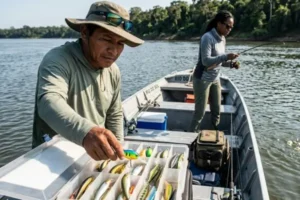
Boat fishing in rivers with the presence of peacock bass in structured environments requires a set of technical decisions that directly influence performance in the field. Among these decisions, choosing the right rod is one of the most important, especially when the goal is to work with precision in areas filled with natural obstacles such as submerged logs, branches, and aquatic vegetation.
Fast-action rods stand out in this scenario because they offer immediate response, greater lure control, and higher casting precision. This type of equipment is widely used in sport fishing across different regions, including rivers in South America and also North American river systems where predatory species use structures as shelter and feeding points.
To understand why this rod type is so effective, it is necessary to analyze not only its technical characteristics but also fish behavior, environmental dynamics, and how the angler interacts with the overall setup.
Understanding Peacock Bass Behavior in Structured Areas
Peacock bass is a species strongly associated with submerged structures. In natural river environments, it typically occupies areas with logs, rocks, roots, and aquatic vegetation, where it finds both protection and feeding opportunities.
These locations function as strategic points within the river ecosystem. The fish uses them as ambush zones, remaining still or making short movements until it detects potential prey. When this happens, the strike tends to be fast and direct.
This behavior requires a more precise approach from the angler, since the action window is limited and response time must be quick. For this reason, rod selection must consider not only casting performance but also immediate line and lure control after the lure hits the water.
Why Fast Action Matters in Obstacle-Rich Environments
Rod action refers to where the rod bends during use. In fast-action rods, most of the flex occurs in the upper section, while the rest of the blank remains more rigid.
This characteristic provides important advantages in structured environments. The first is casting precision, as energy is transferred more directly. This allows accurate lure placement even in small openings between structures.
Another advantage is lure control during retrieval. Fast action helps the angler feel contact with the environment more clearly and react quickly when needed. This is essential in situations where fish may appear suddenly.
In addition, this type of rod improves fish control immediately after the hookset, helping guide the fish away from structures that could interfere with landing.
Ideal Rod Length for Casting Near Structures
Rod length directly affects accuracy and control in boat fishing. In structured environments, shorter rods are usually more effective.
Models between 5’6” and 6’3” are commonly used in these situations. They allow quicker and more precise movements, making it easier to work in tight spaces within the boat.
Shorter rods also reduce the risk of hitting branches during casting and provide better control when guiding the lure through obstacles.
On the other hand, slightly longer rods can be useful when reaching targets farther inside the same structure. The ideal choice depends on the environment and fishing strategy.
Blank Selection for Sensitivity and Immediate Response
The blank is the main body of the rod and plays a key role in sensitivity. It determines how energy is distributed along the rod during use.
In peacock bass fishing in structured areas, a stiffer and more responsive blank is generally preferred. This allows anglers to detect subtle bites and react quickly to line changes.
Modern materials such as high-modulus carbon composites are widely used due to their combination of lightness and strength. This improves comfort during long sessions without sacrificing sensitivity.
A responsive blank also contributes to better hookset control, increasing efficiency during fish capture.
Rod Power for Lure Work and Fish Control
Rod power refers to its ability to handle load during use. In environments with peacock bass and submerged structures, medium to medium-heavy rods are commonly used.
This power range allows anglers to work different types of lures, from lighter options to larger ones used in more aggressive setups.
It also helps maintain control after the hookset. In structured environments, this is essential to prevent fish from quickly moving toward cover.
A properly selected power rating improves lure handling and ensures better control during retrieval.
Guide Types for Better Performance with Braided Lines
Guides are responsible for directing the line along the rod, directly influencing casting and retrieval smoothness.
For braided lines, reinforced guides with smooth internal finishes are recommended. They reduce friction and increase durability.
This results in more consistent casting performance and better lure control, especially in situations requiring precision in tight spaces.
Proper guide selection also helps preserve line condition over time.
Handles and Grip for Boat Fishing Control
The rod handle plays a major role in comfort and control during boat fishing. In structured environments, where movements are frequent and quick, this detail becomes even more important.
EVA grips are widely used due to their strong grip even in wet conditions. Cork handles, on the other hand, offer a lighter and more traditional feel.
The handle shape also affects ergonomics. A well-designed grip improves control during casting, retrieval, and hookset actions while reducing fatigue.
Tackle Balance for Better Precision in Tight Spaces
Rod performance depends not only on the rod itself but also on how it is balanced with the reel and line. In tight spaces, this balance becomes even more critical.
A properly matched setup allows for accurate short-distance casting and smooth line control during lure retrieval. This reduces mistakes and improves consistency.
Good system balance also helps maintain stability during repeated movements in confined fishing areas.
Rod and Reel Combinations for Better Balance
The reel should complement the rod in both weight and function. Low-profile reels are widely used in boat fishing due to their control and ergonomic benefits.
When the setup is properly balanced, the angler can perform more precise movements and maintain control for longer periods without discomfort.
This balance also directly affects casting quality and lure presentation.
Choosing fast-action rods for boat fishing in rivers with peacock bass in structured areas involves analyzing several technical factors. Length, power, sensitivity, guides, and overall setup balance all work together to determine final performance.
When these elements are properly aligned, anglers gain better precision, improved lure control, and higher efficiency in complex environments. Understanding these variables allows for smarter adaptation to conditions, making the fishing experience more consistent and technical.