
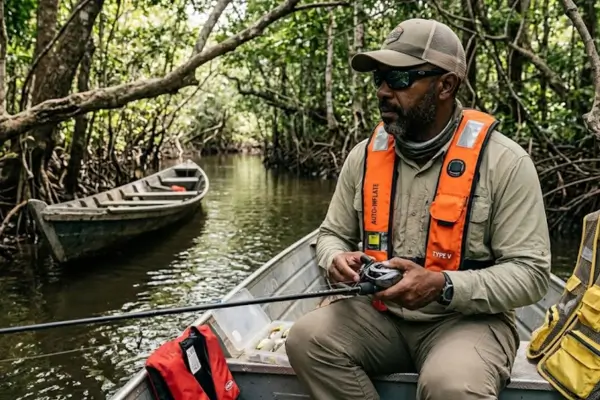
Boat fishing in rivers with narrow navigation sections requires a high level of organization inside the vessel. The limited space, combined with constant movement for casting and retrieving, means that every piece of equipment directly impacts overall performance.
In this context, the life jacket is no longer just a support item but becomes part of the functional structure of fishing. It must provide comfort, mobility, and stability at the same time, without interfering with rod, reel, or accessory handling.
Choosing the right life jacket can significantly improve movement flow inside the boat and contribute to a more efficient fishing experience in confined navigation environments.
Importance of Life Jackets in Narrow Navigation Sections
In narrow river sections, navigation requires more precision in boat handling and greater attention to positioning inside the vessel. The internal space is usually limited, which makes any bulky equipment more noticeable during movement.
In this environment, the life jacket must allow the angler to move freely. This includes turning the body for casting, adjusting foot positioning, and shifting sides within the boat.
The life jacket also contributes to body stability during boat movement. In narrow river sections, small directional changes are more frequent, requiring constant balance from the angler.
When properly selected, the life jacket does not interfere with fishing dynamics and helps maintain control throughout the activity.
Difference Between Inflatable and Traditional Foam Life Jackets
Life jackets used in boat fishing generally fall into two main categories: inflatable and traditional foam models. Each type has specific characteristics that directly influence comfort and mobility.
Inflatable life jackets are known for their compact design. When not activated, they take up very little space on the body, allowing greater freedom of movement. This is especially useful in small boats where space is limited.
Traditional foam life jackets, on the other hand, have a fixed structure and provide constant support. They are bulkier but offer continuous stability without the need for activation.
In practice, the choice between these two types depends on fishing style, movement frequency, and personal preference regarding comfort and practicality.
Adjusting the Life Jacket for Freedom of Movement on the Boat
Proper adjustment of the life jacket is one of the most important factors for ensuring good performance in narrow navigation environments. A poorly adjusted jacket can restrict essential movements such as raising the arms during casting.
Side and front straps should be adjusted so that the jacket stays firmly on the body without excessive compression. The goal is to maintain stability without limiting mobility.
A well-adjusted life jacket allows the angler to perform wide rod movements without interference in posture or balance.
This is especially important in fishing sessions that require frequent casting and constant repositioning inside the boat.
Compact Profile Models for Reduced Spaces
In smaller boats or situations with multiple anglers onboard, compact-profile life jacket models are highly recommended.
These models have reduced front and side bulk, which minimizes contact with other equipment and improves movement inside the boat.
The reduced volume also improves ergonomics during rod handling, especially during side casts or quick movements.
Even with a lighter structure, these life jackets still maintain the necessary functionality for boat fishing environments, offering a balance between comfort and practicality.
Weight Distribution and Comfort During Long Periods
Comfort during long fishing sessions is a key factor in angler performance. A well-designed life jacket distributes weight evenly, reducing pressure on areas such as the shoulders and back.
This balanced distribution helps prevent discomfort during repetitive activities like casting and retrieving.
Comfort also directly influences focus and movement precision. When the angler is comfortable, they can maintain more consistent execution patterns.
In long fishing sessions, this factor becomes even more important.
Closure Systems for Greater Body Stability
Closure systems are responsible for keeping the life jacket securely in place during use. They may include buckles, zippers, and adjustable straps.
An efficient system prevents the jacket from shifting during movement or position changes inside the boat.
This ensures greater stability when handling the rod and improves body control in situations with reduced balance support.
Well-designed closure systems also allow quick adjustments throughout the fishing session when needed.
Materials Resistant to Continuous Use in Humid Environments
Fishing in river environments exposes equipment to constant humidity and changing weather conditions. For this reason, life jacket materials must be durable and resistant.
High-quality fabrics help maintain the structure of the jacket even after long periods of use in humid conditions.
Another important factor is quick-drying capability, which improves comfort during continuous use.
Durable materials also extend the product’s lifespan, reducing the need for frequent replacement.
Pockets and Compartments for Quick Access to Essential Items
Some life jacket models include pockets and compartments designed for storing small fishing items.
These spaces are useful for organizing accessories, tools, and other lightweight equipment needed during fishing.
Pocket placement should be designed to avoid interfering with arm movement during rod handling.
In confined boat environments, this organization improves efficiency and responsiveness during fishing.
Choosing Sizes for Different User Types
Selecting the correct life jacket size is essential for ensuring both comfort and efficiency. A jacket that is too large may shift during movement, while a tight one may restrict mobility.
For this reason, it is important to choose a size that matches the user’s body type while also considering adjustment options.
Adjustable models offer greater flexibility since they can adapt to different body shapes.
Proper sizing ensures better performance and comfort throughout the entire boat fishing session.
The appropriate life jacket for boat fishing in rivers with narrow navigation sections plays a key role in mobility, comfort, and organization.
The choice between inflatable and foam models, proper adjustment, correct sizing, and material quality all directly influence the fishing experience inside the boat.
When properly selected and adjusted, the life jacket becomes a functional piece of equipment that supports more efficient, organized, and comfortable fishing in restricted navigation environments.