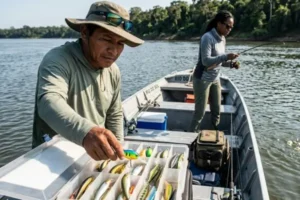
Fishing in areas with submerged branches and other natural structures requires a high level of control during casting and lure presentation. In boat fishing situations, where space is limited and precision is more important than distance, low-profile baitcasting reels are widely used due to their compact design, ergonomic handling, and responsive mechanics.
However, consistent performance in these environments depends not only on equipment quality but also on how each adjustment is tuned according to lure type, casting distance, and environmental structure. Understanding these settings allows anglers to improve accuracy, reduce casting inconsistencies, and maintain better lure control in complex fishing scenarios.
Challenges of Casting Near Submerged Branches
Casting near submerged branches creates a highly technical environment where precision is more important than casting distance. These areas contain irregular structures, tight openings, and unpredictable shapes formed by wood, roots, and aquatic vegetation.
The main challenge is placing the lure accurately into small openings without deviating from the intended path. Small variations in casting force, rod angle, or reel adjustment can significantly affect the outcome.
These locations often hold active fish, which makes proper lure placement even more important. The lure must enter the target zone naturally and without unnecessary disturbance.
For this reason, anglers must focus more on fine tuning their equipment rather than relying on casting strength alone.
How Spool Control Impacts Casting Precision
The spool is one of the most critical components of a baitcasting reel. It controls how the line is released during the cast, and its rotation must stay synchronized with line output.
When the spool rotates faster than the line is being released, inconsistencies can occur in the casting flow, affecting accuracy. This imbalance may cause the lure to drift away from the intended target.
When spool control is properly adjusted, the line flows smoothly and consistently, allowing the lure to follow a predictable path.
This becomes especially important in short-distance casting situations where even minor errors can move the lure out of the target zone.
Magnetic Brake Adjustment for More Refined Control
The magnetic braking system regulates spool speed using magnetic resistance. It stabilizes spool rotation during the casting motion.
Higher magnetic braking settings increase control by reducing spool speed, which is useful for short and precise casts near structures. Lower settings allow for longer casts but require greater skill in spool management.
Finding a balanced setting based on lure weight and environmental conditions is essential for maintaining consistent performance.
When to Use Centrifugal Brakes for Casting Stability
The centrifugal braking system applies internal friction based on spool rotation speed. It is most effective during the initial phase of the cast when spool acceleration is highest.
This system helps stabilize spool behavior at the beginning of the cast, reducing irregular movement and improving consistency. It is particularly useful when casting into tight areas where control is more important than distance.
Many modern reels combine centrifugal and magnetic systems, allowing for more precise tuning based on fishing conditions.
Tension Knob Adjustment for Smooth Line Release
The tension knob controls the initial resistance applied to the spool before casting begins. It determines how freely the spool can rotate at the start of the cast.
A tighter adjustment increases control but may reduce casting distance. A looser adjustment allows smoother line release but requires more spool control from the angler.
Finding the right balance is essential for consistent casting performance in structured environments.
Balancing Speed and Control During Casting
One of the key aspects of using low-profile reels effectively is balancing casting speed with control. Faster casts can improve efficiency but often reduce precision in tight spaces.
Controlled casts allow better lure placement into specific openings within submerged structures. Adjusting casting force and reel settings together helps maintain consistency.
This balance is especially important when working in environments with irregular openings and limited target space.
Adjustments for Different Lure Weights and Types
Different lures behave differently during casting due to variations in weight, shape, and air resistance. Heavier lures require less braking force, while lighter lures need more controlled settings to maintain stability.
Adjusting the reel according to lure weight improves casting consistency and reduces spool irregularities.
This flexibility also allows anglers to switch between different lure styles more efficiently during a fishing session.
Practical Testing for Refining Setup in the Field
Field testing is essential for fine tuning reel settings. Even properly calculated adjustments may need modification depending on real fishing conditions.
Testing different brake settings, tension levels, and casting techniques helps identify the most effective configuration for each environment.
Over time, this process improves consistency and helps anglers adapt quickly to changing conditions.
Common Mistakes in Reel Adjustment in Structured Environments
Some common mistakes can reduce casting efficiency in structured fishing areas:
- Using excessive braking that limits casting smoothness
- Ignoring lure weight when adjusting spool settings
- Keeping the same configuration for all conditions
- Failing to fine tune the tension knob
Avoiding these mistakes helps improve casting precision and overall control in complex environments.
Proper adjustment of low-profile reels plays a critical role in improving casting performance near submerged branches and structured environments. Each setting, from spool control to braking systems, directly affects accuracy, stability, and consistency.
When properly tuned, the setup allows for better lure placement and improved adaptability to challenging fishing conditions. This results in more efficient performance and greater consistency during boat fishing in structured waters.