
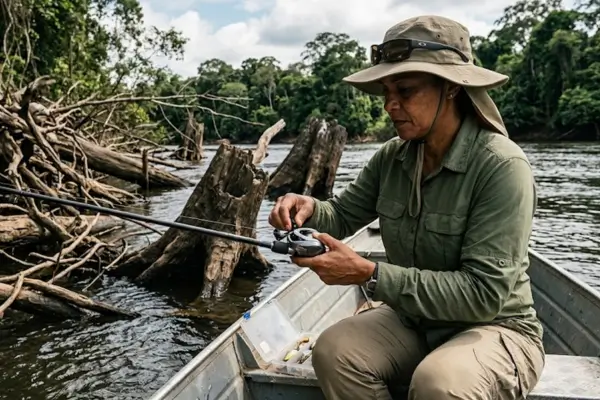
Fishing near submerged logs, branches, roots, and other natural structures requires a high level of equipment control. These environments are highly complex and directly influence the behavior of the fishing line, lure, and rod and reel setup.
In these conditions, having quality equipment alone is not enough. It is necessary to understand how each component works together and how small adjustments can significantly change performance during casting and lure presentation. A proper setup improves accuracy, environmental reading, and consistency during fishing.
Challenges of Fishing Near Logs and Natural Structures
The presence of logs, submerged branches, and aquatic vegetation creates a highly structured environment. These elements form shaded areas, shelter zones, and movement corridors for fish, especially predatory species.
At the same time, these structures limit available space for lure movement and require more precise casting. Small deviations can cause the lure to miss the intended target area.
Another challenge is the constant contact between the line and irregular structures, which requires careful control during both retrieval and lure handling.
In addition, reduced visibility in certain river sections can make environmental reading more difficult, increasing the importance of proper equipment setup.
How Setup Balance Affects Control
Balance between rod, reel, and line is one of the most important factors in structured fishing environments. When the system is properly balanced, the angler’s movements are transmitted more efficiently to the lure.
This allows for greater casting precision and more stable lure control. An unbalanced setup can create inconsistencies in line release and negatively affect lure positioning.
Proper balance also improves comfort during extended use, reducing physical effort and maintaining consistent motion throughout the fishing session.
Choosing the Rod for Quick Response in Tight Spaces
The rod plays a key role in lure control. In environments with natural obstacles, faster-action rods are generally more effective.
Fast-action rods provide immediate response to angler input, improving lure control in limited spaces.
Rod length also directly affects performance. Shorter rods offer better control in confined areas, while slightly longer rods may help with precision in more open sections of the river.
Rod sensitivity is also important, as it allows anglers to detect lure interaction with underwater structures and adjust their technique accordingly.
Reel Adjustment for Greater Casting Precision
The baitcasting reel is essential for line control during casting. In structured environments, precision is more important than distance.
Brake system adjustment is crucial for controlling line release speed. This helps prevent irregular line flow that can affect lure trajectory.
Spool tension adjustment also plays an important role. A balanced setting allows smoother and more controlled line release, especially in short and precise casts.
Proper adjustment improves stability during lure retrieval and reduces unwanted variations in movement.
Balancing Power and Sensitivity in the Setup
A well-designed fishing setup must balance power and sensitivity. Power is necessary for handling stronger fish and working in areas with dense structure.
Sensitivity allows the angler to detect lure behavior and any interaction with the environment.
When these two elements are balanced, the angler can maintain control even in demanding conditions while still perceiving subtle changes in line behavior.
This balance is especially important in environments with logs and branches, where constant control is required.
Line Control in High Snag Potential Areas
Line control is one of the most critical aspects in structured environments. The way the line is released and retrieved directly impacts fishing performance.
Maintaining proper line tension helps reduce interference with underwater obstacles and improves lure control.
Line type selection also affects performance. Stronger lines with lower stretch tend to provide better control in structured environments.
Anglers must continuously monitor line behavior to maintain efficiency throughout the fishing process.
Ergonomics of the Setup for Precise Movements
Equipment ergonomics directly influence movement quality. A comfortable setup allows for better control and precision during extended use.
Rod grip should provide stability without discomfort, enabling smooth and controlled movements.
Reel positioning should also support easy handling, especially during repetitive casting.
When the setup is ergonomic, the angler can maintain consistent movement patterns, which is essential in structured environments.
Adjustments for Different Lure Types in Structured Environments
Each lure type requires specific adjustments. Lighter lures need greater control during casting to maintain accuracy.
Heavier lures require different reel and rod settings to ensure stability during launch.
Lure behavior in water also influences setup adjustments. Lures with more active movement may require finer control during retrieval.
Adapting the setup to the lure type significantly improves performance in structured environments.
Common Mistakes in Setup Configuration in Obstacle Areas
Some common mistakes can reduce fishing efficiency:
- Using unbalanced rod and reel combinations
- Incorrect reel brake adjustment
- Choosing the wrong rod length for the environment
- Poor line tension control during use
- Not adapting the setup to lure type
- Using the same configuration in different fishing conditions
Avoiding these mistakes improves consistency and control in structured environments.
Proper rod and reel setup configuration is essential for fishing in areas with logs and natural obstacles. Balance between components, reel adjustments, and rod selection directly influence control, precision, and overall efficiency.
When properly configured, the setup performs better in complex environments, improving lure presentation and increasing consistency throughout the fishing process. Understanding these elements helps anglers adapt more effectively to river conditions and continuously refine their technique.